


Heavy-Duty Truck Brake Disc Cracking and Warping: Driver Errors and Correct Use
Among the most critical mechanical subsystems that directly determine the operational safety of international logistics, intercity heavy haulage, construction-site transport and large truck fleets carrying tons of cargo is the braking equipment. On heavy commercial vehicles that struggle to bring huge masses to a halt over thousands of kilometers, from Turkish highways to the rugged motorways of Europe, brake discs are exposed to extreme thermal and mechanical stress, with temperatures reaching hundreds of degrees, at every stop. In the disc-brake axle architectures of leading heavy-vehicle brands such as Mercedes-Benz, Ford F-Max, Scania, MAN, Volvo, Iveco and Renault, kinetic energy is converted into enormous frictional heat during braking. However, demanding road conditions, intensive mountain descents, overloading and incorrect braking habits occasionally cause surface cracks, thermal shock fractures and geometric distortion (runout) on heavy-duty brake discs. A cracked or warped brake disc does not merely cause vibration at the pedal; it is a critical failure that dangerously lengthens stopping distance, can lock the drum or the pads, and invites serious traffic accidents.
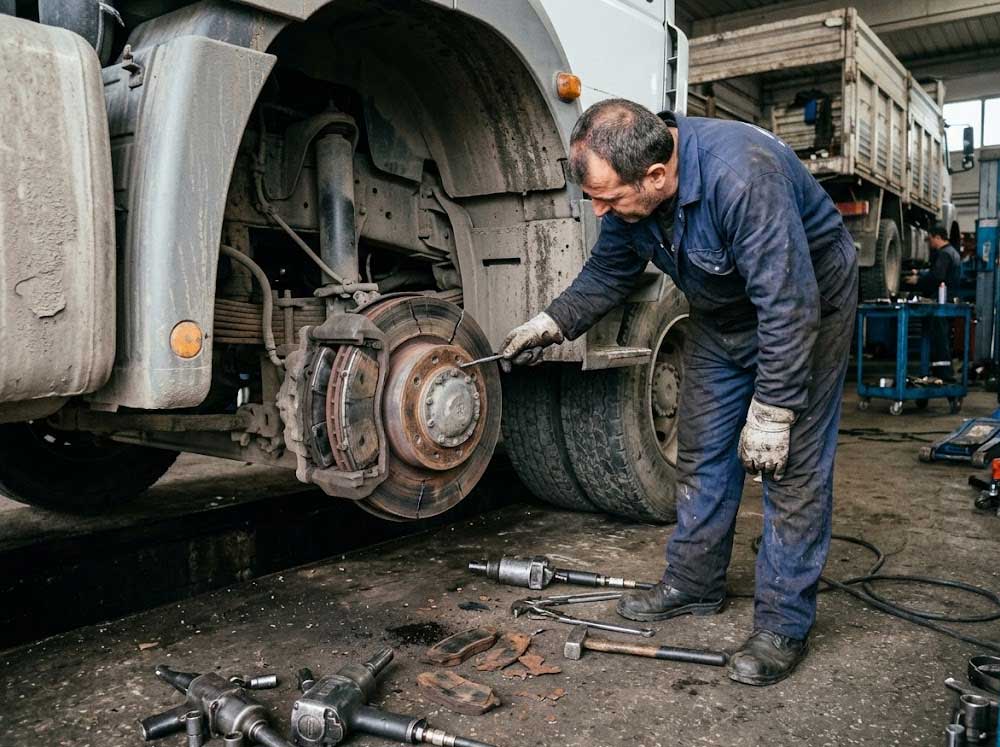
How the Disc Brake System Works on Heavy Vehicles and the Thermal Stresses Involved
On heavy commercial vehicles, the disc brake system is an extremely robust mechanism made up of ventilated brake discs cast from cast iron or high-alloy steel, pad carriers, hydraulic-pneumatic caliper pistons and high-pressure air lines. When the driver presses the brake pedal while the vehicle is moving, the high pressure delivered to the caliper pistons through the EBS modulators clamps the pads against both faces of the disc and resists its rotation. The enormous heat released by this friction is expelled through the disc's internal air channels (ventilation vanes). However, when a 40-tonne truck descending a long grade keeps pressing the brake pedal continuously to slow the rotational momentum of the wheels (driving without intermittent application and release), disc temperature quickly rises above 600-700 degrees Celsius. This overheating beyond metallurgical limits creates sudden expansion differences between the outer surface and the inner body of the disc and sets the stage for thermal stresses.
Why Do Brake Discs Crack? Causes of Thermal Shock and Metallurgical Fatigue
The formation of spider-web hairline cracks on the surface of heavy-duty brake discs, or a disc splitting deeply in the radial direction and breaking apart, is usually the result of thermal shock combined with incorrect usage habits. When an overheated brake disc suddenly enters a deep puddle after a long mountain descent, or contacts a layer of icy water on the road in winter, the outer surface cools and contracts abruptly. While the inner part is still hot and expanded, this sudden contraction of the outer surface exceeds the yield strength of the metal and causes thermal shock cracks to break out. In addition, aftermarket brake discs made from poor-quality cast material have unbalanced carbon and alloy ratios, so even the slightest temperature fluctuation can make the disc crack or dome.
How Does Brake Disc Warping (Runout) Occur and How Does It Affect the Driver?
Besides cracking, another chronic problem frequently encountered is the disc deviating from its geometric axis and bending, that is, runout. Disc warping makes itself known through clear symptoms felt in the cab: on motorway drives, when the brake pedal is lightly touched, a rhythmic shudder, pulsation or rumbling begins in the steering wheel and brake pedal. The main factors behind warping are as follows:
- Continuous Friction and Pad Sticking: If the caliper slides rust or the caliper pins seize, the pad keeps rubbing lightly against the disc even when the brake is released. This leads to localized overheating and bending at a certain point of the disc.
- Overloading and Sudden Water Contact: On heavy vehicles that exceed tonnage limits, the mechanical load on the discs during braking is very high; if water splashes onto a hot disc at that moment, it triggers thermal warping.
- Uneven Tightening of Wheel Nuts: Tightening the wheel nuts unevenly or in the wrong sequence with an air gun instead of a torque wrench after tire changes or maintenance distorts the wheel hub and therefore the surface on which the disc sits, causing disc runout.
Driver Errors: Overusing the Service Brake Instead of the Retarder and Engine Brake
One of the biggest mistakes heavy-vehicle drivers make in traffic is constantly pressing the foot brake (service brake) on long downhill stretches instead of using the auxiliary braking systems, namely the retarder and the engine brake, effectively. The retarder works hydraulically or electromagnetically at the transmission output to brake the vehicle and transfers the heat to the engine and coolant, whereas service brakes rely entirely on the pads and discs. When the driver tries to slow tons of load using only the disc brakes, the discs have no chance to cool and remain constantly at maximum temperature. This damages the metallurgical structure of the discs and causes both premature cracking and the pads burning and forming a glazed layer.
Professional Solution Steps, Machining and Disc Replacement Criteria
The course of action for repairing cracked or warped brake discs must be determined carefully according to the extent of the damage. Discs with deep thermal cracks on the surface, with hairline cracks reaching the edge windows of the disc, or below the manufacturer's minimum thickness limit must never be machined; these discs must be replaced immediately, in pairs (per axle), with new discs that meet original equipment (OEM) standards. Discs with only light surface runout and vibration and with thickness within the limit can be corrected on special disc lathes, either removed from the hub or skimmed precisely on the vehicle. However, after machining, it is mandatory to fit new pads and to clean the hub surface completely of rust.
Correct Use Discipline in Fleets and Mesay Otomotiv Solutions
To extend brake disc life and eliminate the risk of breakdowns on the road, heavy-vehicle fleets should regularly train drivers in the use of the retarder and the engine brake. In maintenance workshops, low-quality aftermarket products should be avoided during disc replacement, and original-equipment discs with high thermal conductivity and alloy strength should be preferred. Cleaning the hub surfaces and observing wheel nut torque values are the most basic technical rules for preventing disc warping.
With our decades of technical experience in heavy commercial vehicle transmissions, differentials, engines and braking systems and our strong stock infrastructure, we supply the logistics sector with original brake discs, brake pad sets and caliper overhaul kits for all heavy-vehicle groups such as MAN, Mercedes-Benz, Scania, Volvo, Ford Cargo, Iveco and Renault. To keep your fleet's braking safety at the highest level, prevent the operational disruptions caused by sudden disc cracks and safeguard road safety, we remain your most reliable business partner with our wide product range and fast logistics network.
