


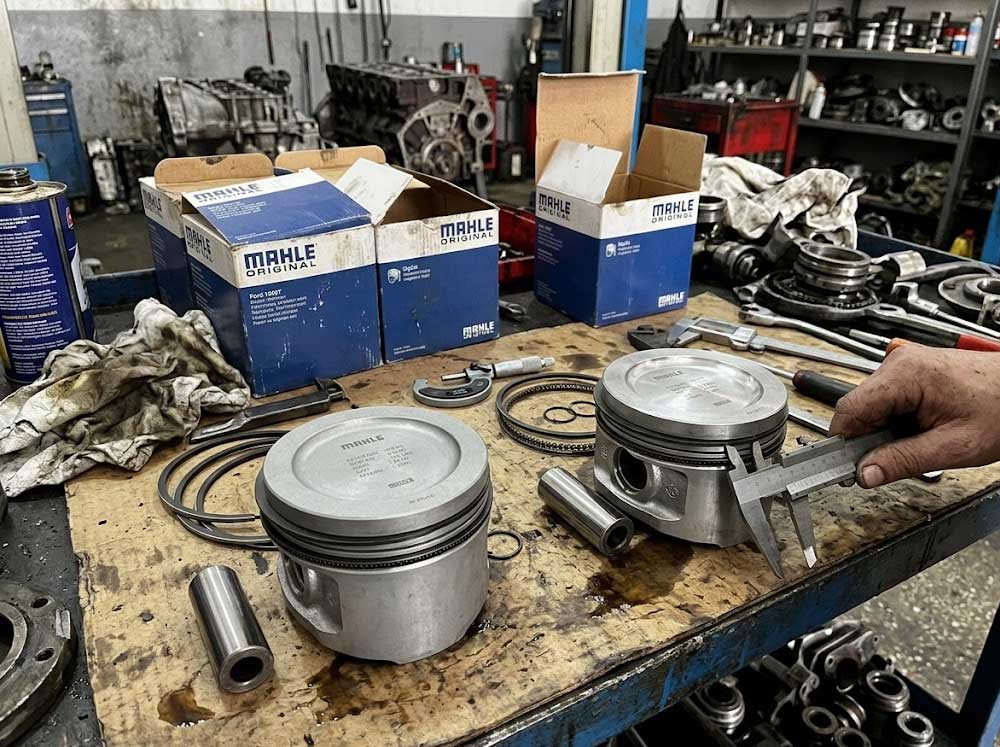
Mahle Ford 1838T Euro 5 Yellow Engine Standard and Oversize (Half-Size) Pistons
In the heavy commercial vehicle industry, international haulage, logistics operations, earthmoving and heavy-tonnage freight depend directly on the durability and flawless performance of the engine assemblies that form the mechanical heart of the vehicle. One of the most preferred heavy-duty models on Turkish highways and international routes, legendary for its power and torque capacity, is the Ford Cargo series, which stands out in the sector especially with its powerful Euro 5 Ecotorq engines. Known in the automotive world and among technical service workshops as the "yellow engine" because of its instrument details, engine architecture and technical building blocks, this special power unit delivers uninterrupted power while climbing the steepest grades with loads weighing tons, in harsh climates and under an intensive duty cycle. However, over hundreds of thousands or even millions of kilometres of heavy work, the internal mechanical components of the engine are exposed to enormous heat cycles, constantly high combustion pressures and huge friction forces. When a heavy-duty engine is overhauled or rebored, choosing the right piston group, the most critical moving element of the combustion chamber, is a vital factor that directly determines the life and efficiency of the engine. The standard and oversize (half-size, "buçuklu") piston variants developed specifically for the Ford 1838T Euro 5 yellow engine by Mahle, a world leader in automotive and industrial metallurgy, are among the finest engineering solutions that restore the engine fully to its original factory performance.
Heavy-Duty Torque Production in Commercial Vehicles and an In-Depth Analysis of Ecotorq Euro 5 Yellow Engine Technology
The Euro 5 Ecotorq engine used in Ford Cargo 1838T tractor units has an advanced turbocharged, direct-injection architecture capable of producing huge torque even at low revs. In this special "yellow engine" series, in-cylinder combustion pressures are many times higher than in passenger-car or light commercial engines. Diesel fuel, injected into the cylinder by injectors at thousands of bar, ignites within fractions of a second inside the special combustion bowl at the piston crown and produces an enormous expansion force. This force strikes the piston crown directly and is transmitted through the piston pin to the connecting rod and then to the crankshaft, where it is converted into the rotary motion delivered to the wheels. In heavy-duty haulage, every piston of the engine does not merely produce power; it also absorbs in its body the thermal and mechanical shock waves created by these explosions, repeated thousands of times per minute. The performance continuity of the Ecotorq Euro 5 yellow engine therefore depends directly on the material quality, metallurgical purity and thermal expansion coefficient of the piston used. Mahle engineering produces piston designs that match the thermodynamic characteristics of this particular engine, protecting the limits of the engine block in the safest way.
The Role of the Piston in Diesel Engine Thermodynamics and Mahle's Metallurgical Production Standards
In heavy-duty diesel engines the piston is not just a simple metal mass that transmits power; it is a multi-functional thermomechanical component that separates the combustion chamber from the crankcase, transfers high heat to the cylinder walls and from there to the coolant, and provides a seat for the piston rings. While temperatures at the piston crown reach hundreds of degrees during combustion, this heat must be carried away from the piston body quickly. Mahle uses special aluminium-silicon alloys in manufacturing the pistons for the Ford 1838T Euro 5 yellow engine. This special alloy never loses its mechanical strength even at high temperatures and keeps thermal conductivity at its maximum. In addition, because the first ring groove of heavy-duty pistons is prone to wear over time due to extreme combustion pressures, Mahle integrates nickel-alloy cast ring-carrier inserts known as "Ni-resist" into this area. Thanks to this advanced technology, deformation in the ring groove is reduced to zero, and the rings are prevented from sticking in the groove or widening it. The special friction-reducing coatings applied to the piston skirts prevent scoring of the cylinder walls during the first cold-start moments of the engine and minimise internal mechanical losses.
The Effect of Standard-Size Mahle Pistons on Engine Compression, Oil Consumption and Bearing Integrity
When a heavy-duty engine is completely rebuilt or taken in for a bottom-end overhaul, the inner surfaces of the cylinder liners are subjected to detailed micrometric measurements. If no taper, ovality, deep scratches or surface deterioration is found in the cylinder liners, and liner replacements are made to the standard factory diameters, standard-size Mahle pistons are the preferred choice for the engine. A standard-size piston re-establishes exactly the factory running clearances of a zero-kilometre engine block. This millimetric running clearance between the piston and the cylinder wall prevents high-pressure combustion gases from leaking into the crankcase. In engine literature this is called maintaining compression and preventing the blow-by problem. Standard-size Mahle pistons achieve a perfect geometric match with the ring sets and wipe the oil film on the cylinder surface flawlessly; this reliably prevents the engine from burning oil, blue smoke from the exhaust and excess oil vapour reaching the turbocharger system. At the same time, because equal mass and weight balance is achieved in all six cylinders, the centrifugal loads on the crankshaft and main bearings are balanced and the engine runs with smooth acceleration, free of vibration.
Oversize and Half-Size Piston Selection Criteria in Reboring Operations and Honing Precision
In commercial vehicles that carry heavy loads for hundreds of thousands of kilometres, the cylinder blocks or liners wear at micron level because of friction and thermal stresses and lose their form. When the block surfaces have to be machined, ground and honed on reboring machines, the cylinder bore grows beyond its original size. In such cases standard-size pistons cannot be used because they would leave too much clearance in the cylinder; this is where the oversize and half-size ("buçuklu") Mahle piston groups come into play. Engine machinists enlarge the cylinder bore according to the amount of wear on the block and select the matching oversize pistons (prepared in full or half-step tolerances). Because oversize and half-size Mahle pistons are manufactured to precise tolerances, they match exactly the honing angle and diameter produced on the reboring machine. Leaving the piston clearance tighter than necessary causes the piston to expand when the engine warms up, seize in the cylinder and lock, while leaving it looser than necessary causes the piston to rattle in the cylinder and leads to loss of compression. Thanks to their flawless geometric form, Mahle oversize pistons allow rebored engines to run with the ideal piston clearance, just like a brand-new factory engine, and completely eliminate the risk of premature wear.
Piston Ring Tolerances, Piston Pin Bearing Fit and Connecting Rod Balancing Dynamics
The piston group does not consist of the aluminium body alone; it performs as a whole together with the ring set and pin fitted to it. Mahle piston kits prepared for the Ford 1838T Euro 5 yellow engine are supplied with compression, oil-control and spring-loaded ring combinations that withstand high torque and pressure conditions. The ring end gaps inside the cylinder and the vertical freedom of movement in the piston groove directly affect the engine's oil control and sealing. The high-strength piston pins in Mahle piston kits are made of case-hardened steel and are made resistant to massive knocking loads. The close-sliding fit of the piston pin in the piston bosses and the connecting rod bushing prevents clearance knock that could occur as the engine revs. Furthermore, in six-cylinder Ecotorq engines the weight differences between each piston-pin-ring set must be equal down to fractions of a gram. Mahle's precise weighing and manufacturing discipline equalises power distribution among the cylinders, balances the torsional moments on the crankshaft and extends the life of the engine mechanics many times over.
Fuel Injection Geometry, Combustion Bowl Design and Euro 5 Emission Efficiency
In modern diesel engines, lowering emission values and increasing fuel efficiency are directly related to the architecture of the combustion chamber. The combustion bowl in the crown of the Ford 1838T Euro 5 yellow engine piston has a special angle and depth that allows the diesel droplets sprayed from the injector nozzle to mix with air at the ideal turbulence ratio. In manufacturing these pistons, Mahle replicates and refines the original Ford Ecotorq combustion chamber geometry with micron-level precision. Thanks to the flawless angles of the combustion bowl, the atomised fuel is distributed evenly to every point of the combustion chamber and burns completely. Complete combustion helps maximise engine torque and reduces the soot formation caused by unburnt fuel. Reduced soot accumulation in turn protects the catalyst and DPF structures in the Euro 5 exhaust emission system and preserves the vehicle's AdBlue consumption balance. As a result, logistics companies achieve significant cost savings both in the fuel tank and in the exhaust emission system.
Choosing the Right Part for Long-Life Engine Overhauls in Heavy-Duty Fleets, and the Mesay Otomotiv Guarantee
For heavy commercial vehicle fleets, taking a truck into the workshop for an overhaul means high downtime costs, that is, lost time and lost earnings. For this reason, choosing aftermarket pistons of uncertain quality or with mismatched tolerances in the engine renewal of high-performance vehicles that are constantly on the road, such as the Ford 1838T, is an extremely serious financial risk. A cheap piston with faulty thermal expansion tolerance can seize in the cylinder at the slightest overheating, causing the block to crack, the connecting rod to bend and the engine to be scrapped completely. Choosing OEM-quality Mahle pistons is the most sensible investment: it seals the quality of the engine overhaul and gives the vehicle hundreds of thousands of kilometres of uninterrupted running. At Mesay Otomotiv, with our decades of technical experience in the heavy commercial vehicle sector, our wide product range and our strong stock infrastructure, we offer all Mahle standard and oversize piston options for the Ford Cargo 1838T Euro 5 yellow engine group to the logistics sector. We deliver the high-strength original spare parts you need for the powertrain, engine blocks and running gear of your heavy vehicles to your workshops through our fastest logistics network, and with our expert team providing technical support we are always by your side as the most reliable business partner, to protect your fleet's torque power on the road, its fuel efficiency and its operational stability.
