


TRUCK LOSING COOLANT: HOW TO DETECT RADIATOR, HOSE OR THERMOSTAT FAILURES
TRUCK LOSING COOLANT – HOW TO DETECT RADIATOR, HOSE OR THERMOSTAT FAILURES
For long-haul truck drivers and fleet managers, the engine temperature gauge on the dashboard climbing into the danger zone or the coolant level in the expansion tank constantly dropping is a serious warning sign. The complaint “the truck is losing coolant” can indicate a wide and potentially catastrophic range of faults, from a simple loose clamp that is easy to repair to failures in internal engine gaskets. Due to high engine output, constant heavy loads and long duty cycles, heavy commercial vehicles are the class of vehicles that depend most on proper thermal management. Any malfunction in the cooling system or a truck radiator failure is far more than a minor leak; it is a warning sign of a high-cost risk of engine seizure.
In this comprehensive article, we present an expert-level fault diagnosis guide to help you understand why your truck is constantly losing coolant. From the radiator core to flexible hoses, from the critical thermostat to vital internal engine gaskets, you will learn how to pinpoint the source of the problem step by step and how to guarantee your engine’s safety for hundreds of thousands of kilometers by choosing the right parts.
The Anatomy of the Cooling System: Why Does the Coolant-Loss Chain Reaction Start?
Truck engines need a coolant (a mixture of water and antifreeze) that circulates continuously in a closed, high-pressure system to keep under control the enormous heat generated by combustion. Loss of this fluid means there is a leak somewhere in the system that is releasing pressure to the outside. Sometimes this leak appears as an external seep that can even be seen with the naked eye; sometimes it seeps into the engine (internal leak), and this second type is always more difficult to detect and far more dangerous.
The root cause of coolant loss must be sought in different wear zones of the mechanical components:

1. External Leaks: Visible but Insidious Losses
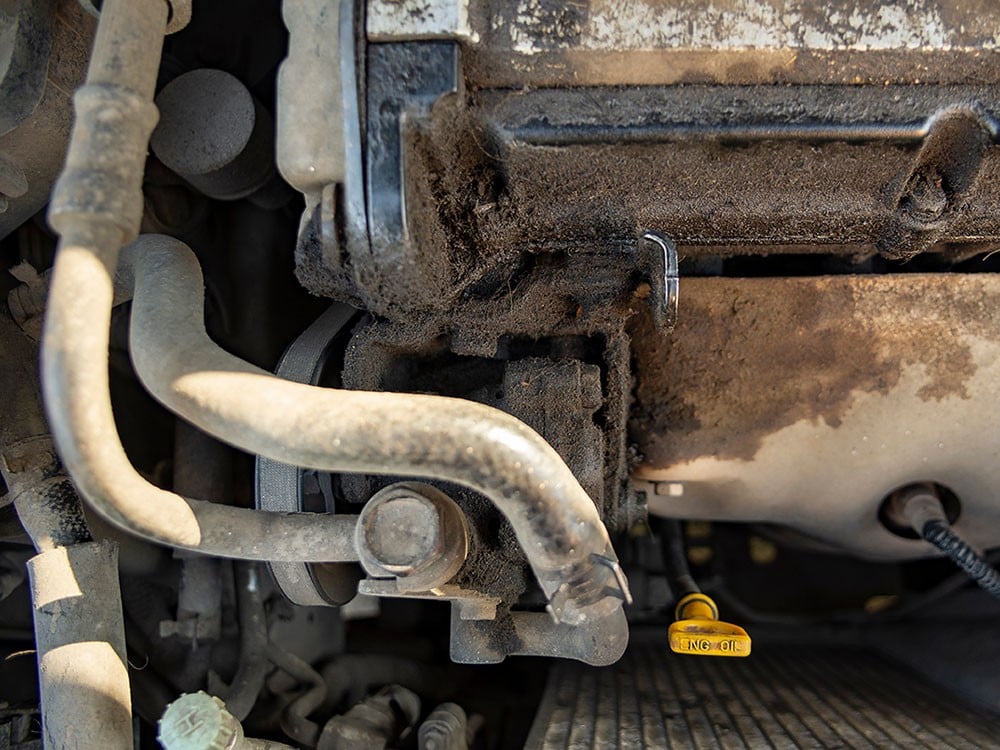
External leaks are the first stage in the fault-finding process. The most common weak points are flexible truck hose failures. Radiator and heater hoses, which operate under high temperature and pressure and are constantly exposed to vibration, gradually lose their elasticity, harden, crack and begin to drip coolant when the system is pressurized under operating conditions. Loosening or corrosion of the metal clamps where the hoses are connected to the radiator or engine also causes leaks.
The second major source of external leakage is the radiator itself. Capillary cracks in the radiator core caused by excessive vibration, stone impacts from the front or internal corrosion due to aged antifreeze result in small damages that create continuous but slow coolant loss. Leaks due to worn gaskets or the mechanical seal (shaft seal) around the water pump (circulation pump) are also common. In particular, a faulty expansion tank cap that cannot hold pressure causes the coolant to evaporate and vent to the atmosphere at high temperature. This is the first point to check on vehicles that lose coolant even though no visible leak is present.
2. Internal Leaks: Damage Spreading Inside the Engine
Internal leaks occur when coolant seeps into engine oil, the combustion chamber or the exhaust system and represent the most dangerous scenario, completely threatening the healthy operation of the engine. The primary cause of this type of leak is usually a cylinder head gasket failure. Due to overheating, high thermal stress or head bolts tightened with incorrect torque, the gasket burns, cracks or deforms. Coolant leaking into the combustion chamber burns together with the fuel and exits through the exhaust as dense, sweet-smelling white smoke; if this continues even after the engine has warmed up, it is a clear sign that the gasket has failed.
Even worse, coolant leaking into the crankcase mixes with engine oil, diluting it and completely destroying its lubricating properties. This makes the oil on the dipstick look milky and creamy. Foaming of the oil in this way poses a deadly risk for main bearings and pistons; in this scenario, the risk of engine seizure is extremely high. Deep cracks in the cylinder block or cylinder head can also cause internal leaks and will multiply overhaul costs.
3. Thermal Control and System Pressure Problems
A thermostat failure in the system does not directly cause coolant loss, but it does pave the way for overheating and triggers chain-reaction leaks. If the thermostat remains closed, it prevents coolant from reaching the radiator to be cooled. The engine overheats, system pressure rises excessively and this pressure bursts weak gaskets, old hoses and radiator cores, making overheating inevitable. If the thermostat opens too early, it prevents the engine from reaching its ideal operating temperature, increasing fuel consumption and reducing engine efficiency. Keeping the engine at the correct temperature is vital for the thermal health of the pistons.
A Systematic Step-by-Step Guide to Fault Diagnosis
When faced with the problem that the truck is losing coolant, staying calm and following a systematic approach is essential for accurate diagnosis.
Step 1: Thorough Visual Inspection and Pressure Test
When the engine is completely cold, the expansion tank and coolant level should be checked. Then the engine is started and the temperature gauge monitored carefully. While the engine is hot and under pressure, every part of the system must be inspected, including the radiator, all hose connections, the water pump area, heater hoses and heat-exchanger connections inside the cabin. Areas that drip coolant when under pressure will clearly show the location of the leak. If no visible leak is detected, a professional pressure test must be performed. In this test, compressed air is introduced into the system and the rate at which the pressure drops over a certain time is measured. If the pressure drops but no external leak is observed, the likelihood of an internal leak increases significantly and further tests are required.
Step 2: Oil and Exhaust Checks (Clues to Internal Leaks)
When an internal leak is suspected, the first thing to check is the engine oil. The dipstick is removed and the color and consistency of the oil are examined. If the oil has a creamy foam or milky appearance, this indicates a mixture of coolant and oil and clearly confirms a cylinder head gasket failure. Next, the color and smell of the exhaust smoke are analyzed; dense, white, sweet-smelling smoke that does not dissipate like normal water vapor is a sign that coolant is entering the combustion chamber. Finally, the coolant in the radiator is checked for oil spots, oil rings or continuous bubbles (engine gases entering the coolant); this further supports the diagnosis of gasket damage.
Step 3: Thermostat Function Check and Coolant Circulation
The engine warm-up time is critical to determine whether the thermostat is opening and closing correctly. After the engine is started, the upper radiator hose should remain cold until the thermostat reaches a certain temperature (usually 80–90°C). If the engine overheats very quickly but the radiator hoses are still cold, it means that the thermostat is stuck closed and the coolant cannot circulate. Replacing the thermostat ensures that the engine runs neither too cold nor too hot and is a critical safeguard for engine life and fuel efficiency.
Correct Part Selection: Guarantee of Engine Protection and Brand Assurance
When carrying out repairs or parts replacement in cooling system failures, compromising on quality puts the entire engine at risk. Choosing products from globally specialized brands in radiators and cooling systems such as NRF, NISSENS and TITANX ensures that the system withstands high pressure and thermal load for a long time and provides maximum efficiency in heat transfer.
• Radiators: Low-quality radiators quickly lose heat-transfer efficiency and start to leak in a short time. Radiators offered by brands such as NRF or NISSENS are fully warranted solutions with high heat-transfer efficiency, matched to the truck’s payload and engine output.
• Hoses and Gaskets: Cooling hoses and gaskets are the only components constantly exposed to high pressure and temperature changes. Choosing these parts in OE quality minimizes the risk of leakage and prevents hose bursts.
• Thermostat: The correct opening and closing temperature of the thermostat is critical to engine efficiency and safety. A high-quality thermostat is the most reliable guarantee that the engine remains at its ideal temperature.
The cooling system is the engine’s insurance policy. Investing in your system protects you from far more expensive repairs such as cylinder head gasket replacement, shortens downtime, prevents early engine wear and, most importantly, keeps you from being stranded on the road. The complaint that the truck is losing coolant should never be ignored; the fault must be correctly diagnosed and high-quality cooling system components must always be used to maintain your truck’s operational reliability. Do not put your engine’s health at risk.
For technical information and expert supply support regarding guaranteed radiators, thermostats and water pump solutions under the NRF, NISSENS or TITANX brand, suitable for the make and model of your truck, contact our specialists immediately.
