


Why Does a Retarder Leak Oil? Heavy-Duty Truck Muffler and Cooler Failures
International road haulage, logistics operations and heavy-duty freight require tonnes of cargo to be delivered safely over mountain passes, long motorways and steep gradients. One of the most critical safety mechanisms behind these huge operations is the retarder: a hydrodynamic auxiliary brake that protects the brake linings of loaded trucks and tractor units from overheating and burning out on long descents. Instead of loading thousands of newton-metres onto the service brakes, these systems slow the vehicle through the resistance of hydraulic oil between the rotor and stator vanes integrated on the transmission output shaft, multiplying the brake life of heavy vehicles. However, one of the most frequent fault signals that this complex hydraulic assembly gives over time, under constant high temperatures, high-pressure cycles and heavy mechanical stress, is an oil leak. A leaking retarder does not just create environmental contamination; it also loses its hydraulic oil, completely loses its ability to slow the vehicle, and damages other critical components around the gearbox and engine. Examining in depth the main causes of retarder oil leaks, the damage that occurs in the muffler and cooler units, and the effects of these faults on the heavy vehicle is vital for fleet management and mechanical maintenance safety.
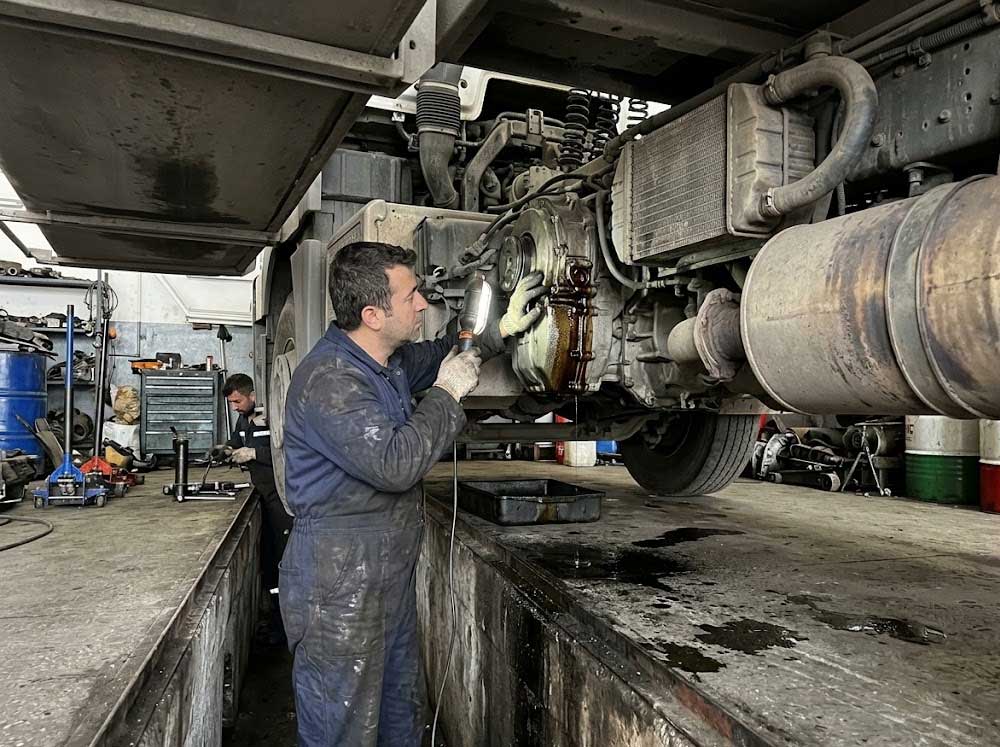
Basic Mechanical Causes of Oil Leaks in Hydrodynamic Retarder Systems
Hydrodynamic retarders used in heavy commercial vehicles work on the principle of using special transmission oils or hydraulic fluids under high pressure. When the system is engaged, the rotor vanes pump the oil at high speed against the stator, and this frictional resistance converts kinetic energy into heat, which is then cooled. During this process the oil temperature inside the system can reach extreme levels within a short time, and the internal pressure rises enormously as a result. The sealing elements used on the retarder housing joint faces, cover gaskets, seal seats and O-rings gradually lose their elasticity under these heat fluctuations and chemical wear. Hardening, cracking or deterioration of rubber-based seals is among the primary factors that allow high-pressure oil to escape. In addition, runout on the transmission output shaft, bearing play or wear in the shaft seats misaligns the rotating assembly, causing the seals to be crushed on one side and to leak within a very short time. Choosing non-original aftermarket seals that cannot withstand heat and pressure during maintenance also makes leakage problems unavoidable.
Cooler Failures and Oil-Water Mixing Problems
Efficient operation of the retarder depends on the huge amount of heat it generates being dissipated through the vehicle's main coolant circuit or dedicated radiators. At this point the retarder oil cooler (heat exchanger) is the most critical component, transferring heat between the hydraulic oil and the engine coolant without letting them mix. The thin metal tubes inside the cooler core can be perforated or cracked over time by cavitation, poor-quality antifreeze, electrolytic corrosion or excessive pressure fluctuations. Such internal leaks cause retarder oil to enter the coolant or, conversely, water to enter the hydraulic oil. Retarder oil that gets into the coolant expands and forms a dark, sludge-like thick layer in the radiator tanks and water passages, causing the engine to overheat and the entire cooling system to clog. Water entering the transmission or retarder side destroys the structure of the hydraulic oil and completely eliminates its lubricating properties, paving the way for valve blocks to seize and for the retarder mechanism to burn from the inside and lock up. For this reason, subjecting the retarder cooler to periodic pressure tests and thoroughly chemically flushing contaminated oil and coolant lines is essential to prevent major engine and transmission failures.
Effect of Muffler and Exhaust Integration Problems on Retarder Pressure
In some heavy vehicle and bus groups, retarder systems work in mechanical or pneumatic synchronisation with the exhaust brake or muffler units. A blockage, soot build-up or deformation in the exhaust muffler or exhaust brake flap makes it harder to expel exhaust gas and creates excessive back pressure on the engine and transmission block. This unwanted counter-pressure acts on the air vent passages and valve blocks in the retarder housing and upsets the internal pressure balance. The unbalanced hydraulic system begins to leak heavily from the weakest sealing point it can find (seals, fitting threads or pressure switches). In addition, excessive heat pockets around the muffler scorch, harden and crack the plastic or rubber connection hoses located close to the retarder housing, causing oil or air leaks. This clearly shows how important an integrated maintenance discipline is between the exhaust emission system and the hydrodynamic retarder.
Oil Leaking from Valve Blocks, Proportional Valves and Pressure Switches
The engagement sensitivity of the retarder, the setting of its holding stages and the routing of the hydraulic fluid are handled through proportional valves, solenoids and pressure switches managed by the electronic control unit (ECU). These sensitive valve blocks are usually mounted on the outer surface of the retarder housing and are exposed directly to system pressure. Valve body mounting bolts that are not tightened to the correct torque, that loosen over time due to vibration, or sealing washers at the valve base that become crushed all lead to a sly, continuous outward oil leak. Oil escaping from the threaded bases of pressure switches or from the plastic housing joints can drip onto hot exhaust pipes or engine blocks, filling the cab with a heavy burning smell and even creating a very dangerous fire risk while driving. In such faults, replacing the seal alone is not enough; the valve block seats, threads and O-ring grooves must be inspected down to micron level, and deformed connection elements must absolutely be replaced with new original ones.
Effect of Retarder Oil Leaks on Driving Safety and Fleet Costs
Oil leaks in the retarder system may look like a simple dripping problem at first glance, but when the necessary intervention is not made in time they trigger a chain of very costly mechanical disasters. A retarder whose hydraulic oil level drops below the critical limit cannot produce sufficient braking resistance on downhill descents and places the entire load on the vehicle's main service brake linings and drums. Brake linings that overheat quickly burn and glaze, and braking capacity falls almost to zero; this brings the deadly risk of a multi-tonne truck losing its brakes and running away. On the other hand, leaking oil sticking to the running gear and collecting road dust to form a thick layer both prevents transmission heat from dissipating and causes the vehicle to be recorded with a serious defect during inspections. In fleet management, just as much as fuel saving and operational continuity, meticulously checking the sealing of vital slowing systems such as the retarder during periodic maintenance is the most fundamental way to avoid unexpected roadside assistance costs.
Choosing the Right Spare Parts in Professional Diagnosis and Maintenance
Once retarder oil leaks, cooler perforations and muffler integration faults are identified, the quality of the repair depends directly on the standard of the spare parts used and the technical knowledge of the technician. After the faulty retarder is removed, all internal passages must be cleaned of metal burrs and deposits with special solvents, and the operation of the valve blocks must be tested on pressure test benches. Seal sets, O-rings, gasket papers and heat exchangers used during renewal must fully comply with original equipment manufacturer standards; otherwise the same leakage problems will recur shortly. As Mesay Otomotiv, we offer our high-strength spare part solutions for the powertrain and brake support systems of heavy commercial vehicles with our rich stock infrastructure. By choosing quality components in retarder and transmission overhauls, you can protect your fleet's road safety, braking stability and operating efficiency at the highest level and extend the life of your heavy vehicles with confidence.
