


Fuel Filter Failure Symptoms and Replacement Time
If the engine is the heart of a heavy-duty vehicle, the diesel fuel filter is the most sensitive guardian of the veins that feed that heart. Especially in modern trucks and lorries with high-pressure injection systems (Common Rail), even a microscopic dirt particle or a drop of water in the fuel can cause injector failures costing thousands of dollars. The diesel fuel filter filters the fuel coming from the fuel tank and ensures that only pure and clean fuel goes to the combustion chamber. However, over time, this filter reaches saturation point or becomes clogged early due to the use of poor-quality fuel. In this guide, we will examine in full technical detail how a professional can detect problems in the diesel fuel filter early and why replacement timing is vital.
The Function of the Diesel Fuel Filter and Its Critical Position Within the Fuel System
Diesel fuel, by its nature, is a fuel that is prone to contamination at many stages, from production to storage. Sediments, paraffin crystals and, most dangerously, water in the fuel create an abrasive effect when they reach the engine’s injector nozzles. The diesel fuel filter captures these harmful substances and protects both the fuel pump and the injectors. Heavy-duty vehicles generally have two-stage filtration: a pre-filter that holds coarse dirt and a main filter that performs micron-level filtration. If these filters cannot perform their duty, the pressure balance inside the fuel system is disrupted and the operating character of the engine changes completely. The filter papers used in modern heavy-duty vehicles have the technology to filter even particles many times smaller than a human hair. When such a sensitive barrier becomes full, it becomes impossible for the system to breathe.
The Most Common Symptoms of Diesel Fuel Filter Failure and Clogging
A diesel fuel filter does not suddenly "break down"; it usually clogs gradually and sends you certain signals. Reading these signals correctly is the only way to prevent being stranded on the road or facing larger engine damage.
Delayed Engine Start or Failure to Start
When you press the starter in the mornings, the engine taking longer than normal to start is one of the clearest signs that the diesel fuel filter is clogged. When the filter is clogged, the fuel pump cannot send fuel to the combustion chamber at sufficient pressure. This delay in the fuel reaching where it needs to go extends the cranking time. If the filter is completely full, the vehicle may not start at all or may stall shortly after starting. This problem becomes even more noticeable especially in cold weather, because while the fluidity of the fuel decreases, the resistance of the clogged filter increases.
Loss of Traction and Poor Throttle Response Problems
If you feel that the vehicle does not pull as it used to, especially while climbing ramps under heavy load, and that the engine responds reluctantly when you press the accelerator, the culprit is most likely the diesel fuel filter. When the engine needs more fuel to produce high power, the clogged filter restricts this flow. This situation is described by the driver as "the vehicle is choking" or "as if someone is pulling it from behind". This loss of power during acceleration can also create a major safety risk during overtaking.
Vibration at Idle and Irregular Operation
If there are fluctuations in the tachometer while your vehicle is waiting at idle, or if you feel an unusual vibration inside the cabin, it means there is an imbalance in the engine’s supply system. When the flow rate of the fuel passing through the filter becomes irregular, the amount of fuel going to the cylinders changes momentarily, and this causes the engine to run shakily. The engine may create a feeling as if one cylinder is not working, which is a reflection of irregular pressure in the fuel system.
Black Smoke from the Exhaust and Increase in Fuel Consumption
A clogged filter disrupts the atomization of the fuel, in other words the spraying quality. Fuel that cannot burn completely is expelled from the exhaust as black smoke. This is not only environmental pollution, but also means that unburned fuel is being wasted. If you have recently noticed an unreasonable increase in your fuel consumption, having the diesel fuel filter checked will be the most logical step for both your wallet and engine health. Inefficiency in the fuel system can cause your fuel costs to increase by 5-10% in a short time.
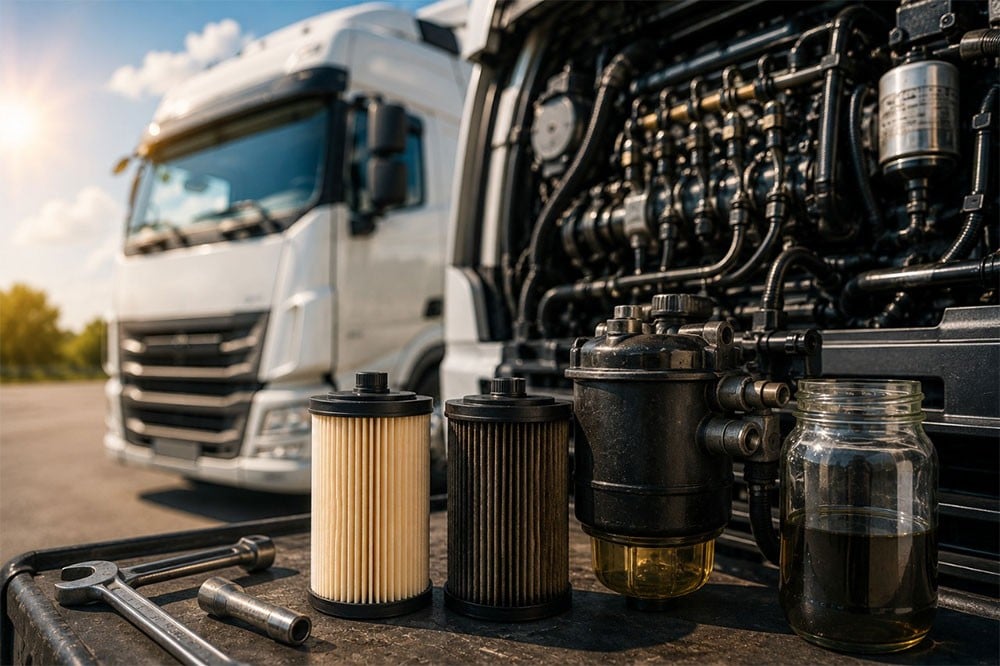
When Should the Diesel Fuel Filter Be Replaced? Factors Determining the Replacement Interval
In heavy-duty vehicles, the replacement time of the diesel fuel filter is not just a mathematical calculation based on kilometers. Many variables can bring this period forward or keep it standard.
Standard Mileage Maintenance
As a general rule, in heavy-duty vehicles, the diesel fuel filter must be replaced at every periodic maintenance interval (between 30,000 - 60,000 km depending on the vehicle). However, the service computers of modern vehicles can continuously measure fuel pressure and warn the driver when it is time to replace the filter. Instead of waiting for this warning, it is always safer to stick to planned maintenance. Professional fleets generally minimize risks by bringing this interval slightly earlier than the limit values set by the vehicle manufacturer.
The Effect of Fuel Quality on Replacement Time
If you buy fuel from stations you do not know along your route or if you work in dusty environments such as construction sites, filter life can be shortened by 50%. The high paraffin or sediment content in poor-quality fuel closes the pores of the filter in a very short time. The price of buying "cheap diesel fuel" is usually paid with filters that clog early and injectors that fail. Especially fuels purchased from stations whose storage tanks are not cleaned can render the filter unusable even with a single filling.
Seasonal Transitions and Winter Conditions
In winter conditions, the paraffin in diesel fuel tends to freeze and gel. This gelled structure can completely clog the diesel fuel filter overnight. For this reason, replacing the diesel fuel filter before entering winter and after winter prevents the accumulated moisture (water) and frozen paraffin in the system from damaging the engine. Although winter fuels contain additives, water particles in an aged filter can freeze and completely cut off fuel flow.
The Water Separator Inside the Filter and Its Importance
There is usually a transparent chamber or a water drain valve under heavy-duty vehicle diesel fuel filters. Since diesel fuel is lighter than water, the separator inside the filter settles the water to the bottom. Drivers must periodically open this valve and drain the accumulated water. If the water in the system reaches the engine, it causes cavitation (metal breakage) at the injector tips, and it should not be forgotten that this leads to irreversible and costly repairs. Water sensors in modern systems turn on a warning light on the panel and remind the driver that the water needs to be drained; this warning should never be ignored.
Combustion Chamber Health and Injector Protection
The diesel fuel filter is not just a strainer, but also a protective shield that determines the life of the injectors. Modern injectors are parts that open and close many times per second and operate with micron-level precise tolerances. When the filter paper is of poor quality, the micro particles that pass through scratch the paths of these sensitive valves. After a while, the injector nozzles begin to "dribble", meaning they drip the fuel instead of misting it. This situation can start a chain of disasters that may lead to overheating and even perforation of the piston crown. Regular filter replacement is actually the cheapest insurance procedure against a complete engine overhaul.
Why Should You Use Original or OE Quality Filters?
Cheap filters sold in the market under the name of "aftermarket" may look very similar to the original from the outside. However, the real difference is in the micron value of the paper inside the filter. Even if a poor-quality filter paper holds large particles, it lets microscopic particles, which are the engine’s worst enemy, pass through. These small particles wear down the sensitive valves inside the injectors over time. While you may think you are saving money on filter replacement in the short term, in the long term you may face a complete fuel system overhaul. Choosing products with original standards from brands such as Bosch, Mann, Donaldson or Fleetguard is equivalent to insuring your engine. In addition, the sealing gaskets of quality filters are much more resistant to high pressure and temperature changes.
The diesel fuel filter is one of the cheapest but most critical parts of a vehicle. Correctly following the symptoms and not delaying the replacement time prevents your vehicle from being stranded on the road while also maximizing engine life. Remember, clean fuel determines the life of the engine, and a well-maintained filter determines the continuity of your business. As Mesay Otomotiv, we are always by your side with the highest quality solutions in your heavy-duty vehicle maintenance processes. We wish you accident-free and prosperous journeys!
