


What is an SCR System Failure? Causes, Symptoms, and Solutions to SCR Problems in Heavy Vehicles.
One of the most important technologies used to reduce emission values in new-generation diesel heavy-duty vehicles is the SCR (Selective Catalytic Reduction) system. The SCR system, found especially in Euro 6 vehicles such as trucks, lorries, tractor units and buses, reduces harmful nitrogen oxide (NOx) emissions in exhaust gases and helps vehicles comply with environmental standards.
However, an SCR system fault may occur over time. An SCR warning on the instrument panel, changes in AdBlue consumption, reduced engine power or limited vehicle performance are among the most common signs of problems in this system.
SCR system faults may directly affect not only emission values but also vehicle performance and operating costs. Especially in commercial vehicles, a problem in the SCR system may cause the vehicle to break down on the road or the engine to enter protection mode.
So, what causes an SCR system fault? How does the SCR system work? What are the symptoms of an SCR fault? What is the connection between the AdBlue system and SCR?
In this article, we examine in detail the most frequently asked topics, such as causes of SCR faults in heavy-duty vehicles, what happens if the SCR system fails, SCR sensor faults, AdBlue-related SCR problems and solutions for SCR faults.
What Is the SCR System and How Does It Work?
SCR stands for "Selective Catalytic Reduction", meaning the Selective Catalytic Reduction System.
This system is used to reduce harmful NOx (nitrogen oxide) gases emitted from diesel engine exhaust systems.
The SCR system mainly consists of the following components:
- AdBlue tank
- AdBlue pump
- AdBlue injector
- SCR catalyst
- NOx sensors
- Exhaust temperature sensors
- Electronic control unit (ECU)
During operation, the system injects a specific amount of AdBlue into the exhaust line. The urea solution in AdBlue is converted into ammonia at high temperatures and reacts with NOx gases inside the SCR catalyst, converting them into harmless nitrogen and water vapour.
This process allows heavy-duty vehicles to operate with lower emission values.
What Does an SCR System Fault Mean?
An SCR system fault means that one of the components within the system responsible for controlling exhaust emissions is not performing its function correctly.
This fault may originate from:
- The AdBlue system,
- Sensors,
- The SCR catalyst,
- The electronic control unit,
- The exhaust system
among other components.
Although the SCR system does not directly produce engine power, faults may cause performance restrictions because it works in connection with the engine management system in modern vehicles.
What Are the Most Common Causes of SCR System Faults?
AdBlue Quality May Affect the SCR System
AdBlue is one of the most important operating elements of the SCR system. AdBlue quality is extremely important for the long service life and correct operation of the system.
When contaminated AdBlue or a product that does not comply with the required standards is used:
- The AdBlue injector may become blocked.
- The pump may be damaged.
- The SCR catalyst may be affected.
- The system may dose incorrectly.
AdBlue stored under unsuitable conditions may crystallise. These crystals can block small channels and injectors within the system, causing faults.
Does an AdBlue Injector Fault Damage the SCR System?
Yes. The AdBlue injector is one of the most critical components of the SCR system.
This component injects the correct amount of AdBlue fluid into the exhaust line.
Injector problems may cause:
- Insufficient AdBlue injection,
- Excessive AdBlue injection,
- Irregular injection,
- Blockage caused by crystallisation
to occur.
When the injector does not operate correctly, the SCR system cannot reduce NOx levels and the vehicle may begin issuing fault warnings.
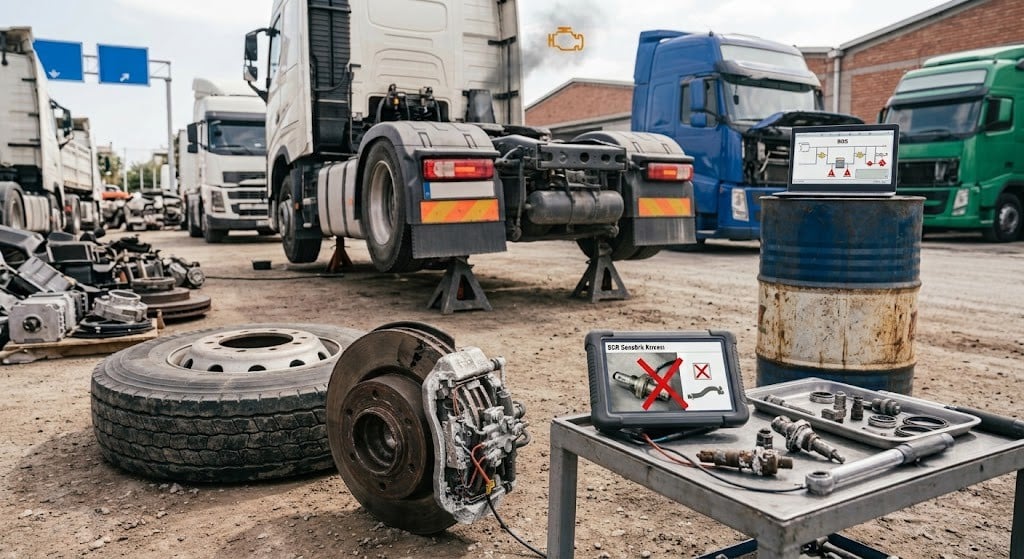
A NOx Sensor Fault Causes an SCR Error
NOx sensors are important electronic components that monitor whether the SCR system is operating correctly.
These sensors measure the amount of nitrogen oxide in the exhaust gas and send information to the ECU.
When a NOx sensor fails:
- The ECU may receive incorrect data.
- The AdBlue quantity may be adjusted incorrectly.
- SCR efficiency may appear low.
- The engine warning light may illuminate.
NOx sensor faults are among the electronic problems frequently encountered in heavy-duty vehicles with Euro 6 engines.
The SCR Catalyst May Become Blocked or Lose Efficiency
The SCR catalyst is the section where the chemical conversion of NOx gases takes place.
Over time:
- Soot accumulation,
- Use of incorrect AdBlue,
- High-temperature problems,
- System faults
may cause the catalyst to lose performance.
When the SCR catalyst does not operate efficiently, the vehicle cannot meet emission limits and the electronic system may generate a fault.
Catalyst faults are generally costly problems. For this reason, system warnings should be addressed early.
Does an Exhaust Temperature Sensor Fault Affect SCR Performance?
Yes. The SCR system operates efficiently within specific temperature ranges.
Exhaust temperature sensors monitor the operating conditions of the system.
When a sensor provides an incorrect reading:
- The AdBlue injection timing may be adjusted incorrectly.
- The SCR system may not operate efficiently.
- Fault codes may be generated.
Temperature sensor problems may sometimes be detected only with electronic diagnostic equipment.
An AdBlue Pump Fault May Disable the SCR System
The AdBlue pump ensures that the fluid moves through the system at the required pressure.
When the pump fails:
- AdBlue pressure decreases.
- The injector does not operate correctly.
- The SCR system cannot provide sufficient reduction.
- The vehicle may issue a warning.
Especially in high-mileage heavy-duty vehicles, the AdBlue pump may lose performance over time.
Electrical and Wiring Problems May Cause SCR Faults
The SCR system operates through the combined operation of many electronic components.
Broken wires, oxidised connectors or communication problems may disrupt system operation.
Electrical SCR faults may cause:
- The warning light to illuminate.
- The system to operate irregularly.
- The fault to appear intermittently.
- The control unit to generate a communication error.
Because of vibration and demanding operating conditions in heavy-duty vehicles, electrical connections should be inspected regularly.
What Are the Symptoms of an SCR System Fault?
SCR faults may appear in different ways.
The most common symptoms include:
- An SCR fault warning on the instrument panel
- The AdBlue level dropping quickly
- The engine warning light illuminating
- AdBlue system warnings
- Engine power restriction
- Increased fuel consumption
- Loss of vehicle performance
- Vehicle start restriction warnings
In some vehicles, the SCR system may reduce engine power after a certain period to prompt the driver to resolve the fault.
Does an SCR Fault Reduce Engine Performance?
The SCR system does not directly produce engine power. However, because it works together with the engine management system in modern diesel vehicles, serious SCR problems may affect performance.
If the vehicle's electronic system detects that emission values cannot be controlled:
- It may limit engine torque.
- It may apply a speed restriction.
- It may enter protection mode.
Especially in commercial vehicles, this may cause operational losses.
How Is an SCR System Fault Diagnosed?
Correct diagnosis is extremely important in SCR faults. Simply clearing the fault code does not solve the problem.
During inspection:
- Fault codes are read.
- AdBlue pressure is measured.
- The injector is inspected.
- NOx sensor values are examined.
- Exhaust temperature values are checked.
- SCR catalyst efficiency is evaluated.
- Electrical connections are inspected.
Replacing components without a correct diagnosis may create unnecessary costs.
What Happens If an SCR System Fault Is Ignored?
If SCR system faults remain unresolved for a long time, they may lead to more serious problems.
Possible consequences include:
- Engine performance restriction
- More serious damage to the AdBlue system
- SCR catalyst failure
- High repair costs
- Vehicle starting problems
- Exceeding emission limits
Especially in heavy-duty vehicles, such faults may cause the vehicle to remain out of service.
How Can SCR System Faults Be Prevented?
Regular maintenance is required for the SCR system to operate reliably over a long service life.
Key points to consider include:
- Use high-quality AdBlue.
- Keep the AdBlue tank clean.
- Do not add unsuitable additives to the system.
- Pay attention to warning lights.
- Have the NOx sensors checked.
- Have the exhaust system maintained.
- Do not neglect periodic vehicle maintenance.
- Have SCR system fault codes checked promptly.
Regular maintenance both extends the service life of the SCR system and helps prevent costly faults.
Frequently Asked Questions
What is an SCR system fault?
An SCR system fault is a condition in which components such as AdBlue, sensors, the pump, injector or catalyst within the exhaust emission reduction system do not operate correctly.
What causes an SCR fault?
The most common causes of SCR faults include the use of poor-quality AdBlue, NOx sensor problems, AdBlue injector failure, pump problems and electrical connection faults.
Will the vehicle operate if the SCR system fails?
In some cases, the vehicle may continue to operate, but in serious faults the system may limit engine power or apply a starting restriction.
Does an SCR fault increase fuel consumption?
It may increase fuel consumption indirectly. When the system does not operate correctly, engine management and emission control processes may be affected.
Does the SCR system work without AdBlue?
No. Without AdBlue, the SCR system cannot perform its NOx reduction function and the vehicle may issue a fault warning.
Why does the SCR catalyst fail?
The use of incorrect AdBlue, system faults, excessive temperatures and prolonged lack of maintenance may damage the SCR catalyst.
How can a NOx sensor fault be identified?
The engine warning light, SCR warnings, increased AdBlue consumption and electronic fault codes may indicate a NOx sensor fault.
How is SCR system maintenance performed?
For SCR system maintenance, AdBlue quality should be checked, sensors and injectors should be inspected regularly, and fault codes should be resolved promptly.
