


When and How Should Differential Oil Be Changed?
Although the engine and transmission are always in view as the main structures that produce and transmit the power of a heavy-duty vehicle, there is a hidden hero that transfers that enormous torque to the wheels and allows the vehicle to take corners safely: the differential. Especially in trucks and lorries carrying tons of load, differential gears operate under incredible pressure and friction. The only thing that prevents metal from rubbing against metal, wearing out, overheating and locking up under these harsh working conditions is differential oil (gear oil).
Differential oil, which is generally neglected because it is not changed as frequently as engine oil, can cause chain-reaction gear breakages and very high-cost repairs when it reaches the end of its life. In this guide, we will discuss in full technical detail why differential oil has critical importance in heavy-duty vehicles, how to understand when replacement time has come and how a correct oil change process should be applied step by step.
What Is the Function of Differential Oil and Why Is It Different from Engine Oil?
Inside the differential, there is a special gear structure called a "hypoid gear", which locks together with very tight tolerances and operates under high torque. The operating character of these gears is very different from engine pistons.
• Need for Extreme Pressure (EP - Extreme Pressure): As differential gears rotate, they literally place tons of load on each other. A normal oil is crushed under this pressure and loses its surface protection feature. That is why special sulfur and phosphorus-based additives called EP (Extreme Pressure) are used in differential oils. These additives form a protective layer on the metal surface and prevent wear.
• High Viscosity (Flow Resistance): While engine oils are fluid and thin, differential oils are much thicker structures with high adhesion capability (For example; 80W-90, which is frequently preferred in heavy-duty vehicles, or heavy-duty 85W-140). This thick structure ensures that a continuous oil film remains on the gears.
How Can You Tell When Differential Oil Needs to Be Changed?
Differential oil ages insidiously. Unlike engine oil, rather than its color, it loses its function by losing its chemical properties and collecting metal dust inside. The clearest signs that a differential oil needs to be changed urgently are as follows:
- Whining and Humming Sounds Coming from the Differential
If you hear a humming or "whining" sound coming from the rear axle area while driving, especially when you exceed a certain speed (usually between 60-80 km/h) or when you press and release the accelerator, it means the differential oil has lost its properties. Because the oil has thinned or decreased, the gears begin to come into direct contact with each other. This sound is the clearest warning that the gears have started to wear and that the differential will lock up completely if no intervention is made.
- Oil Leaks Around the Differential Housing
Oil leaking from axle seals or differential cover gaskets combines with dust on the outer surface of the housing and creates a muddy appearance. Even if the leak looks small, since the total oil volume inside the differential is limited (it is not as high-volume as engine oil), even small losses can reduce the oil level inside to dangerous levels.
- Burnt Smell and Darkening in the Oil
If a heavy burnt plastic or sulfur smell spreads out when the differential oil inspection plug is opened, this indicates that the oil has overheated (overheating). This oil, whose chemical structure has deteriorated, no longer has the ability to protect the gears.
When Should Differential Oil Be Changed?
In heavy-duty vehicles, the differential oil change interval varies depending on the operating conditions of the vehicle, the load being carried and the quality of the oil used (whether it is mineral or synthetic).
• Standard Mileage Maintenance: If long-distance transportation is performed with heavy-duty trucks and lorries, differential oil should generally be changed between 100,000 km and 150,000 km. In high-quality synthetic gear oils, this period may extend slightly depending on manufacturer approval.
• Harsh Conditions (Construction Site and Short Distance): In dump trucks, construction site vehicles, heavy transport vehicles that constantly climb ramps or operate in stop-and-go conditions, this interval should be reduced to 60,000 km to 80,000 km.
• Water Contact Situation: If the vehicle has passed through floodwaters or has been exposed to deep puddles, water may have entered through the differential ventilation plug (breather). Differential oil contaminated with water turns a milky coffee color (becomes muddy) and instantly loses its properties. In such a case, the oil must be changed immediately regardless of mileage.
How Should Differential Oil Change Be Done Step by Step?
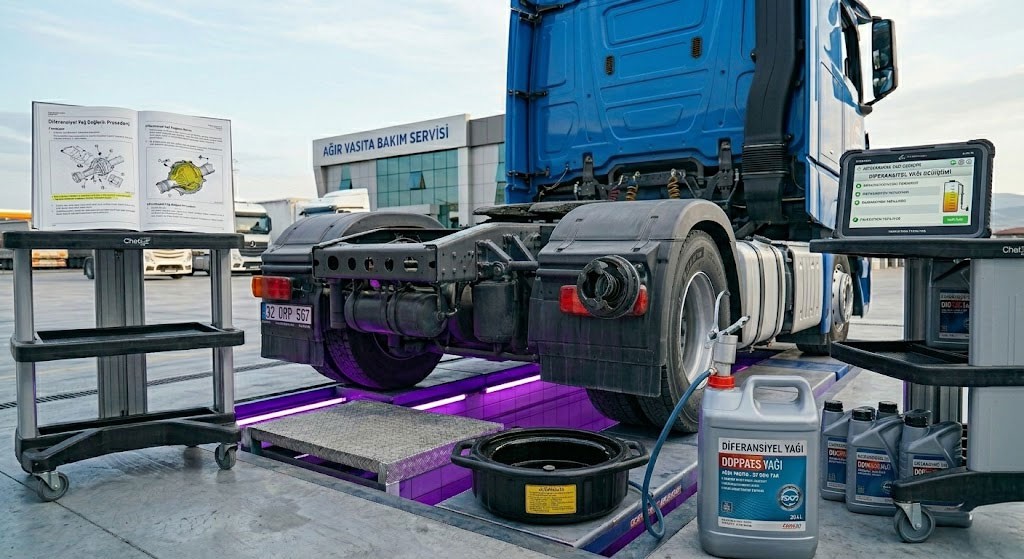
Differential oil change is a process that requires the right equipment and attention. An incorrect application may cause the gears to remain without lubrication. Here is a professional oil change process:
Step 1: Heating the Oil and Preparation
Cold differential oil is very thick and does not drain completely by cleaning the sediments inside, even if the drain plug is opened. Therefore, before the change, the vehicle should be driven for a short distance and the differential oil should be allowed to reach operating temperature. The vehicle should be pulled onto a flat surface and safety precautions (chocking) should be taken.
Step 2: Open the Filling Plug First (Golden Rule)
Very Critical Note: When changing oil, never open the lower drain plug first. Always remove the upper oil filling plug first. If you open the lower plug first and drain the oil, and then realize that the upper plug is stripped or stuck and cannot be opened, you will be left with an empty differential and will not be able to move the vehicle.
Step 3: Draining the Old Oil and Magnet Inspection
After the upper plug is opened, the lower drain plug is removed and the old oil is drained into a suitable waste container. Heavy-duty vehicle differential plugs are usually magnetic. The metal dust accumulated on the tip of the plug should be checked:
• A light gray mud effect: It is a sign of normal wear and should be cleaned.
• Large metal pieces and flakes: This is proof that the gears or bearings inside the differential have started to break. In this case, simply changing the oil is not enough; the differential must be taken in for overhaul.
Step 4: Cleaning the Ventilation Plug (Breather)
On top of the differential housing, there is a ventilation plug that allows the heated air inside to expand and escape. When this plug is clogged with mud, the pressure accumulated inside bursts the axle seals og and causes oil leaks. During the oil change, this breather must definitely be removed and cleaned or replaced.
Step 5: Filling the New Oil and Level Check
After the lower drain plug is thoroughly cleaned and tightened to its torque value, new oil suitable for the specifications stated by the manufacturer (For example: API GL-5 standards) is pumped inside through the upper plug by means of an oil pump.
• What Is the Correct Level? When the oil reaches the lower edge of the filling hole and starts to overflow slightly, it means that the correct level has been reached. In heavy-duty vehicles, an insufficient oil level causes the upper gears to remain without lubrication, while too much oil causes the seals to burst.
What Should Be Considered When Choosing Differential Oil?
Not every gear oil can be put into every differential. Staying loyal to the vehicle catalogue is vitally important.
1. API Standards (GL-4 vs GL-5): Since modern heavy-duty vehicle differentials have high-friction hypoid gears, they almost always require oil in API GL-5 standard. GL-4 oils cannot withstand this high pressure.
2. LSD (Limited Slip Differential) Detail: If your vehicle has a limited slip differential system, the oil to be used must definitely have the LSD statement on it. Otherwise, the locking mechanism cannot engage properly and slips.
Differential oil is the lifeblood of the gear system that transfers the enormous power produced by the engine to the wheels. Paying attention to the specified mileage intervals, not ignoring leaks and correctly analyzing the magnetic plug during replacement protect you from being stranded on the road and from very large financial losses.
As Mesay Otomotiv, we are by your side in all spare part and technical support processes you need, from heavy-duty vehicle powertrain components to differential gears, from bearings to high-quality gears. Do not neglect your maintenance so that your wheels run true and your work is not interrupted. We wish you accident-free and prosperous journeys!
