


Why Doesn't the Retarder Work? Causes, Symptoms, and Solutions for Malfunctions.
One of the most important auxiliary systems for safe driving in heavy-duty vehicles, the retarder helps keep vehicle speed under control, especially on long descents and during high-tonnage transport. By reducing the load on the braking system, it lowers brake pad and disc wear and enables the driver to maintain more controlled and safer driving.
However, in some cases drivers may encounter problems such as the retarder is not working, the retarder does not engage, retarder power has decreased or a retarder fault warning has appeared.
Problems in the retarder system do not only cause a loss of comfort. Especially during long descents with heavy loads, the auxiliary braking system being out of operation may put greater strain on the main braking system and increase safety risks.
So, why does the retarder not work? What are the most common causes of retarder failure? Can the oil level, sensors, electrical system or control unit cause this problem?
In this article, we examine in detail the most frequently asked topics, such as causes of the retarder not working, symptoms of retarder failure, why a truck retarder does not engage, how the retarder system is checked and how retarder faults are resolved.
How Does the Retarder System Work?
A retarder is an auxiliary braking system used to reduce the speed of heavy-duty vehicles. It is widely used especially in trucks, tractor units, buses and high-tonnage commercial vehicles.
Unlike conventional braking systems, the retarder slows the vehicle not through friction, but by generating a counteracting force based on different physical principles.
The main types of retarders used in vehicles are:
- Hydrodynamic retarder
- Electromagnetic retarder
- Transmission-integrated retarder systems
Hydrodynamic systems generally create resistance using oil. Electromagnetic systems generate braking force with the help of a magnetic field.
When the retarder engages, it reduces vehicle speed in a controlled manner and prevents the service brakes from overheating, especially on long descents.
Why Does the Retarder Not Work?
The Retarder Oil Level May Be Low
Oil level is critically important in hydraulic or oil-based retarder systems.
When the oil level is low, the system cannot generate the required pressure and operating conditions. In this case, the retarder may not engage or may fail to provide the expected braking force.
Causes of insufficient oil may include:
- Leaks
- Lack of maintenance
- Seal problems
- Use of incorrect oil
among other issues.
Not only the amount of retarder oil but also its quality is important. Oil that has lost its properties may adversely affect system performance.
The Retarder Control Valve May Be Faulty
The retarder system contains control valves that regulate the oil or operating flow.
When these valves do not operate properly, the retarder may not engage or may lose its staged operating capability.
Control valve problems may cause:
- The retarder not to work at all.
- Some stages not to engage.
- Irregular braking force.
- The system to issue a warning.
Valve faults are generally detected through inspections performed with professional equipment.
Electrical and Sensor Problems May Disable the Retarder
In modern heavy-duty vehicles, the retarder system is managed by electronic control units.
The system uses data received from many sensors in order to operate.
The following components in particular may affect retarder performance:
- Speed sensors
- Brake pedal sensor
- Transmission sensors
- Retarder position sensor
- Electrical connections
If one of the sensors sends incorrect information, the ECU may disable the retarder for safety purposes.
For this reason, when the retarder does not work, not only the mechanical components but also the electronic system should be inspected.
The Retarder Switch or Control System May Be Faulty
In some cases, the problem may not be in the retarder mechanism itself but in the section used by the driver to control the system.
If the retarder lever, button or control system is faulty, the vehicle may not detect the retarder command.
In this case:
- The retarder does not respond at all.
- Some stages do not work.
- There may be no change on the instrument panel.
Even a simple electrical connection problem may cause the retarder to become completely inoperative.
Do Transmission Problems Affect Retarder Operation?
Yes. The condition of the transmission is directly important, especially in retarder systems integrated with the transmission.
Problems related to transmission oil level, pressure values or the electronic control system may affect retarder operation.
Transmission-related problems may cause:
- The retarder not to engage.
- Reduced braking effect.
- The system to generate an error code.
For this reason, transmission inspection should not be neglected in cases of retarder failure.
Brake System Problems May Prevent Retarder Operation
In some heavy-duty vehicles, the retarder works together with the main braking system for safety purposes.
Certain problems within the braking system may prevent the retarder from engaging.
For example:
- ABS faults
- Brake sensor problems
- Air pressure problems
may affect the retarder’s operating conditions.
If the vehicle’s electronic system detects any safety risk, it may limit retarder use.
The Retarder May Have Shut Down Due to Overheating
The retarder may reach high temperatures during intensive use.
To protect itself, the system may reduce its performance or become completely inoperative at certain temperature levels.
Conditions that may cause overheating include:
- Using the retarder at a high level for a long time
- Insufficient oil cooling
- Cooling system problems
- Low oil level
among other factors.
After overheating, the retarder may not work for a while and may engage again after it cools down.
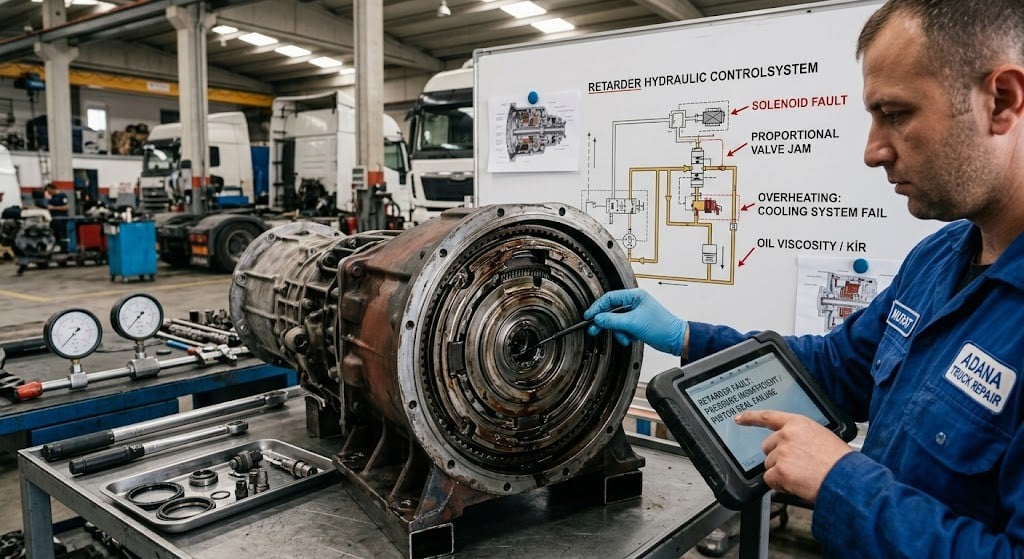
What Are the Symptoms of Retarder Failure?
Problems in the retarder system may appear in different ways.
The most common symptoms are:
- The retarder lever moves but no braking occurs.
- A retarder fault warning appears on the instrument panel.
- The retarder works only at certain stages.
- The braking effect is weaker than before.
- It becomes difficult to control vehicle speed on long descents.
- The system works intermittently and becomes inoperative at other times.
- Electronic error codes are generated.
If any of these symptoms are observed, the system should be inspected.
What Checks Should Be Performed If the Retarder Is Not Working?
A systematic inspection should be carried out to identify the retarder fault correctly.
Points that should be checked include:
- Retarder oil level
- Oil leaks
- Electrical connections
- Sensor values
- Error codes
- Control valves
- Transmission system
- Cooling system
Instead of replacing only one component, the actual cause of the fault should be identified.
Does a Retarder Fault Affect Fuel Consumption?
It is not a system that directly increases fuel consumption. However, when the retarder does not work, driving habits may change.
Especially on long descents:
- The service brakes are used more frequently.
- Vehicle control may become more difficult.
- The braking system is subjected to greater strain.
- Maintenance costs may increase.
For this reason, the retarder is not only a system that provides braking assistance, but also an important piece of equipment that helps reduce operating costs.
How Should Retarder Maintenance Be Performed?
Regular maintenance is extremely important for the retarder system to operate reliably over a long service life.
Key points to consider include:
- Use oil that complies with the manufacturer’s recommendations.
- Have the oil level checked regularly.
- Have leak inspections carried out.
- Have electrical connections checked.
- Do not delay action on fault warnings.
- Do not neglect transmission maintenance.
- Make sure the cooling system is operating properly.
Regular maintenance preserves retarder performance and helps prevent costly faults.
Frequently Asked Questions
Why does the retarder not engage?
The main reasons why the retarder does not engage include low oil level, electrical faults, sensor problems, control valve failures or transmission-related issues.
Is a retarder fault dangerous?
The retarder is not the main braking system, but it provides important support, especially on long descents with heavy loads. If it does not work, the braking system may be subjected to greater strain.
What happens if the retarder oil runs out?
When the retarder oil level decreases, the system cannot generate sufficient pressure and the braking effect may be reduced or the retarder may become completely inoperative.
The retarder is not working, but the warning light is not on. What could be the reason?
Some problems, such as electrical connection issues, control system faults or mechanical wear, may not always trigger a warning light.
Why does the retarder work only at certain stages?
Problems related to stage sensors, control valves or the electronic control system may cause some levels not to operate.
Does using the retarder protect the brake pads?
Yes. The retarder helps reduce brake pad and disc wear by decreasing the load on the main brakes, especially on long descents.
What happens if the retarder overheats?
The system may enter protection mode, reduce its performance or become temporarily inoperative.
What happens if retarder maintenance is not performed?
If regular maintenance is not performed, problems may occur in the oil, sensors, valves and mechanical components. This may lead to reduced system performance and high repair costs.
