


Why Do Heavy Vehicles Emit Black Smoke? Causes and Solutions for Black Exhaust Smoke.
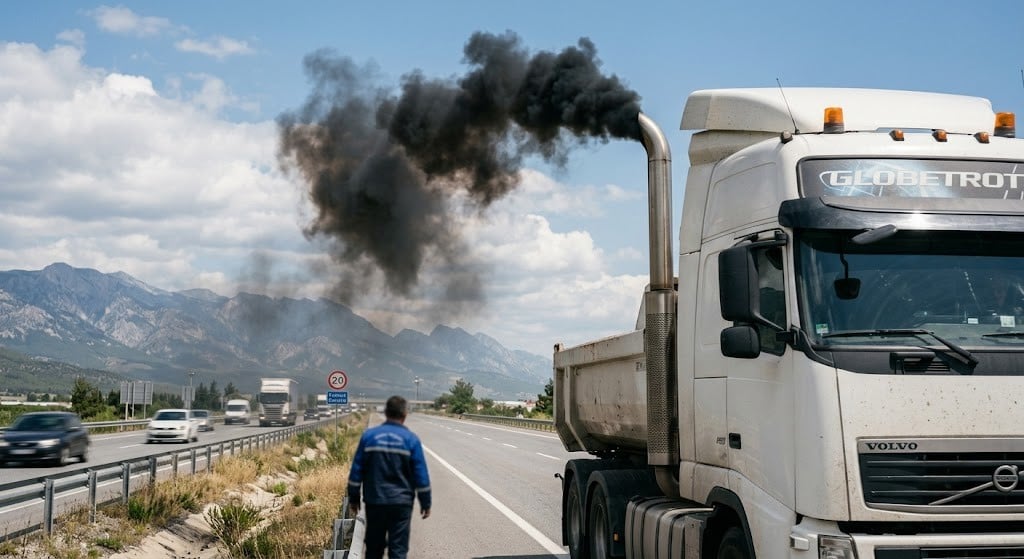
Black smoke from the exhaust of heavy-duty vehicles is one of the common problems encountered by many drivers. Black smoke, especially in diesel-powered commercial vehicles such as trucks, lorries, tractor units, and buses, often indicates that the fuel is not burning completely and that the engine’s ideal operating balance has been disrupted.
Although a certain amount of soot formation is considered normal in diesel engines, dense and continuous black smoke may indicate reduced engine performance, increased fuel consumption, and higher maintenance costs over time.
So, why does a heavy-duty vehicle emit black smoke? Does black smoke always indicate an engine fault? Can the turbocharger, injectors, or air filter cause this condition?
In this article, we examine in detail the most frequently asked topics, such as the causes of black smoke in heavy-duty vehicles, why trucks emit black smoke, black smoke problems in diesel vehicles, and how to solve black smoke coming from the exhaust.
What Does Black Smoke Mean in a Heavy-Duty Vehicle?
Black smoke generally indicates that the fuel-air mixture is not burning properly inside the engine.
Diesel engines require the correct amount of fuel and sufficient air for combustion. When too much fuel is supplied to the engine or not enough air reaches it, all of the fuel cannot burn, and unburned carbon particles are released from the exhaust as black smoke.
This condition is particularly noticeable in the following situations:
- When the accelerator is pressed suddenly
- When driving uphill
- When carrying heavy loads
- During acceleration
- When the turbocharger does not engage
Brief black smoke may be normal in some situations. However, dense black smoke that continues constantly is a problem that must be checked.
Why Does a Heavy-Duty Vehicle Emit Black Smoke?
If the Air Filter Is Clogged, the Engine Cannot Receive Enough Oxygen
One of the most common causes of black smoke is a dirty air filter.
Combustion quality in diesel engines depends largely on the amount of air entering the engine. When the air filter becomes clogged, the engine cannot receive enough oxygen, and the fuel cannot burn completely.
As a result:
- Black smoke is produced.
- Engine performance decreases.
- Fuel consumption increases.
- Throttle response slows down.
The air filter may become dirty more quickly, especially in dusty areas, construction-site conditions, or heavy-duty vehicles that cover long distances.
Can a Turbocharger Fault Cause Black Smoke?
Yes. The turbocharger system plays an important role in black smoke formation in heavy-duty engines.
The turbocharger sends more air into the engine, enabling stronger and more efficient combustion. If the turbocharger cannot generate sufficient pressure, the engine operates with excess fuel but does not receive enough air.
In this case:
- Black exhaust smoke is produced.
- The vehicle loses pulling power.
- Fuel consumption increases.
- Uphill performance decreases.
The main causes of turbocharger-related black smoke include:
- Turbocharger failure
- Leaks in turbocharger hoses
- Intercooler cracks
- Pressure loss
- Turbocharger actuator problems
Especially if black smoke is accompanied by power loss, the turbocharger system must be checked.
Can an Injector Fault Cause Black Smoke?
Injectors ensure that fuel is delivered to the cylinders in the correct amount and at the correct time.
Problems in the injectors impair fuel spray quality. When fuel droplets do not burn properly, soot formation increases and black smoke may come from the exhaust.
Symptoms seen in injector problems include:
- Black smoke
- Engine vibration
- Irregular idling
- Reduced performance
- Increased fuel consumption
- Difficult starting
Using low-quality fuel and extending maintenance intervals may cause the injectors to become dirty more quickly.
The Fuel Pump May Be Supplying Too Much Fuel
Pressure problems within the fuel system can also cause black smoke.
If the fuel pump or fuel pressure system is faulty, more fuel than necessary may be supplied to the engine.
Because the excess fuel cannot combine with sufficient air, it does not burn completely and carbon particles are formed.
Problems originating from the fuel pump may cause:
- Increased black smoke
- Irregular performance
- Higher fuel consumption
- Engine operating problems
to occur.
Black Smoke May Occur If the EGR Valve Becomes Dirty
The EGR system reduces emission levels by recirculating a certain portion of the exhaust gases back into the combustion chamber.
However, soot accumulation over time may prevent the EGR valve from operating properly.
In the event of an EGR fault:
- The combustion balance is disrupted.
- The engine produces more soot.
- Black smoke may be produced.
- Pulling performance may decrease.
EGR soot buildup is more common, especially in heavy-duty vehicles used in urban conditions or operated at low engine speeds for long periods.
MAF and MAP Sensor Faults May Cause Black Smoke
In modern heavy-duty vehicles, the engine control unit (ECU) adjusts the fuel quantity using information received from sensors.
The MAF sensor measures the amount of air, while the MAP sensor measures the intake manifold pressure.
If one of these sensors sends incorrect data:
- The ECU may calculate the fuel quantity incorrectly.
- Too much fuel may be supplied to the engine.
- Black smoke may be produced.
Sensor faults are generally accompanied by:
- Engine warning light
- Loss of performance
- Irregular operation
- Increased fuel consumption
being observed.
Can DPF System Problems Cause Black Smoke?
The diesel particulate filter (DPF) is an important component used to trap soot particles in the exhaust.
Under normal conditions, the DPF reduces the release of black smoke. However, exhaust emission problems may occur if the system malfunctions or operates incorrectly.
In problems related to the DPF:
- Regeneration cannot be completed.
- Engine performance may decrease.
- Fuel consumption may increase.
- The exhaust system may be strained.
The Most Common Causes of Black Smoke in Heavy-Duty Vehicles
| Fault or Problem | Effect on Black Smoke |
|---|---|
| Clogged air filter | Insufficient air reaches the engine, and the fuel does not burn completely. |
| Turbocharger failure | Air pressure decreases, disrupting the fuel-air balance. |
| Turbocharger hose leak | Combustion efficiency decreases due to pressure loss. |
| Injector fault | Fuel cannot be sprayed properly, increasing soot formation. |
| Fuel pump problem | Too much fuel may be supplied to the engine. |
| EGR valve soot buildup | The combustion balance is disrupted and soot formation increases. |
| MAF/MAP sensor fault | The ECU may calculate the fuel-air mixture incorrectly. |
| Intercooler leak | Turbocharged air is lost, reducing performance. |
| Use of low-quality fuel | The injectors and combustion system are adversely affected. |
Does a Heavy-Duty Vehicle Emitting Black Smoke Consume More Fuel?
Yes. Black smoke generally indicates that the fuel is not being used efficiently.
When all the fuel entering the engine is not converted into energy:
- More fuel is consumed.
- Engine performance decreases.
- Component wear may accelerate.
- Operating costs increase.
Especially in fleet vehicles, a heavy-duty vehicle that continuously emits black smoke may cause significant fuel losses in the long term.
Is Black Smoke Harmful to the Engine?
A black smoke problem that continues for a long time may create certain risks for the engine.
If left unchecked:
- The turbocharger may be damaged.
- Injector problems may worsen.
- The EGR system may accumulate excessive soot.
- The DPF may become clogged.
- Engine performance may decrease.
- Fuel costs may increase.
Therefore, black smoke should not be regarded only as an environmental issue; it should also be considered an important indicator of engine health.
How Can Black Smoke from a Heavy-Duty Vehicle Be Prevented?
Regular maintenance and proper driving habits can prevent most black smoke problems.
Points to consider:
- Replace the air filter on time.
- Use high-quality fuel.
- Do not neglect fuel filter maintenance.
- Have the turbocharger hoses checked regularly.
- Have injector tests performed at regular intervals.
- Have the EGR system checked.
- Pay attention to the engine warning light.
- Operate the vehicle at appropriate engine speeds.
Regular maintenance in heavy-duty vehicles not only prevents faults but also directly affects fuel economy and vehicle performance.
Frequently Asked Questions
Why does a truck emit black smoke?
The most common causes of black smoke from trucks are insufficient air, turbocharger pressure problems, injector faults, EGR soot buildup, or problems in the fuel system.
Is it normal for black smoke to appear when accelerating?
Brief black smoke may occur during sudden acceleration. However, dense and continuous black smoke indicates a problem in the engine systems that needs to be checked.
Can a turbocharger fault cause black smoke?
Yes. If the turbocharger cannot generate sufficient air pressure, the fuel-air balance is disrupted, and the engine may run with excess fuel and emit black smoke.
Can a truck emitting black smoke continue to be driven?
The vehicle may still move, but using it for a long time without identifying the cause may lead to more serious faults and higher costs.
Can injector cleaning solve the black smoke problem?
If the problem originates from the injectors, cleaning or repair may provide a solution. However, the cause of the black smoke must be diagnosed correctly.
Can the air filter cause black smoke?
Yes. A clogged air filter prevents sufficient air from entering the engine, causing incomplete fuel combustion and black smoke formation.
Does black smoke increase fuel consumption?
Yes. Because the fuel burns inefficiently, the engine consumes more fuel and operating costs increase.
How is black smoke in a heavy-duty vehicle eliminated?
First, the air filter, turbocharger system, injectors, fuel system, EGR, and sensors should be checked. Maintenance or component replacement should then be carried out according to the source of the problem.
