


Why Won't My Truck Start on the First Turn? Causes and Solutions to the Starting Problem
A truck being difficult to start first thing in the morning, the engine not starting immediately despite cranking, or starting only after several attempts is one of the common problems experienced by heavy-duty vehicle drivers. Especially in trucks used for long-distance transport, vehicles with high mileage or those operating under demanding conditions, the failure to start on the first attempt may result from faults in different systems.
For a truck to start on the first attempt, the battery must provide sufficient electrical power, the starter motor must rotate at an adequate speed, the fuel system must generate the correct pressure and the engine must have the proper air-fuel balance. Even a minor problem in this chain may cause delayed starting.
So, why does a truck not start on the first attempt? Is the battery weak, is there a problem in the fuel system, or is there a more serious fault inside the engine?
In this article, causes of delayed truck starting, why trucks are difficult to start, why heavy-duty vehicles start late in the morning, problems where the starter cranks but the engine does not start and solutions for delayed starting problems are examined in detail.
What Does It Mean When a Truck Does Not Start on the First Attempt?
A truck not starting on the first attempt means that combustion does not begin immediately even though the starter motor turns the engine.
This condition may appear in several different ways:
- The starter motor turns slowly, but the engine does not start.
- The engine starts after cranking for several seconds.
- It is difficult to start in the morning but returns to normal during the day.
- The problem becomes more noticeable in cold weather.
- It does not start on the first attempt but starts on the second or third attempt.
While the source of the problem may sometimes be a simple lack of maintenance, it may also indicate a more serious issue involving the fuel system or engine components.
Why Does a Truck Not Start on the First Attempt?
The Battery May Be Weak
The battery is one of the most important components during the initial starting process of a truck. Large-displacement diesel engines in particular require high electrical power for starting.
When the battery cannot provide sufficient power:
- The starter motor turns slowly.
- The engine cannot be cranked at sufficient speed.
- The fuel injection system may not operate correctly.
- The engine starts late.
Battery problems become more noticeable especially in cold weather. This is because low temperatures reduce battery capacity, while the increased viscosity of engine oil makes initial starting more difficult.
Battery-related problems generally cause symptoms such as:
- The lights dimming while the starter is cranking,
- The starter motor turning heavily,
- Difficulty during the first start in the morning
among other signs.
The Starter Motor May Not Be Turning Fast Enough
Even if the battery is in good condition, problems in the starter motor may make the engine difficult to start.
The starter motor may develop:
- Brush wear,
- Winding problems,
- Bendix failure,
- Internal mechanism wear
which may prevent the engine from being cranked at sufficient speed.
Diesel engines must reach a certain cranking speed for combustion to begin. If the starter motor turns too slowly, the engine may struggle to start even when fuel is injected.
A Blocked Fuel Filter May Cause Delayed Starting
In diesel trucks, the fuel system is critical for the engine's initial start.
Over time, the fuel filter may become blocked by:
- Dirt,
- Sediment,
- Water,
- Foreign substances in the fuel
and similar contaminants.
When the fuel filter is blocked, a sufficient amount of fuel cannot reach the engine.
As a result:
- The engine starts late.
- It may run irregularly after starting.
- Throttle response may weaken.
- Performance may decrease.
This problem may become more noticeable in trucks that have remained parked for a long time due to pressure loss in the fuel line.
Air May Have Entered the Fuel System
Air entering the fuel line is one of the common causes of delayed starting in diesel engines.
When air enters the fuel system:
- Sufficient fuel does not reach the injectors.
- Fuel pressure takes longer to build.
- The engine may start only after several attempts.
Conditions that may allow air to enter the fuel system include:
- Leaks in the fuel hoses,
- Problems with the filter housing,
- Loose fuel connections,
- Operating the vehicle with a very low fuel level
among other causes.
In such cases, the vehicle becomes especially difficult to start after remaining parked for a long time.
Can an Injector Fault Cause a Truck to Start Late?
Yes. Injectors ensure that fuel is injected in the correct quantity and at the correct time in diesel engines.
Problems in the injectors such as:
- Wear,
- Contamination,
- Poor spray pattern,
- Excessive return flow
may affect the engine's initial starting performance.
Injector faults may cause:
- Delayed starting,
- Irregular idling,
- Black or white smoke,
- Performance loss,
- Increased fuel consumption
to occur.
Injector inspection is an important maintenance step, especially in high-mileage trucks.
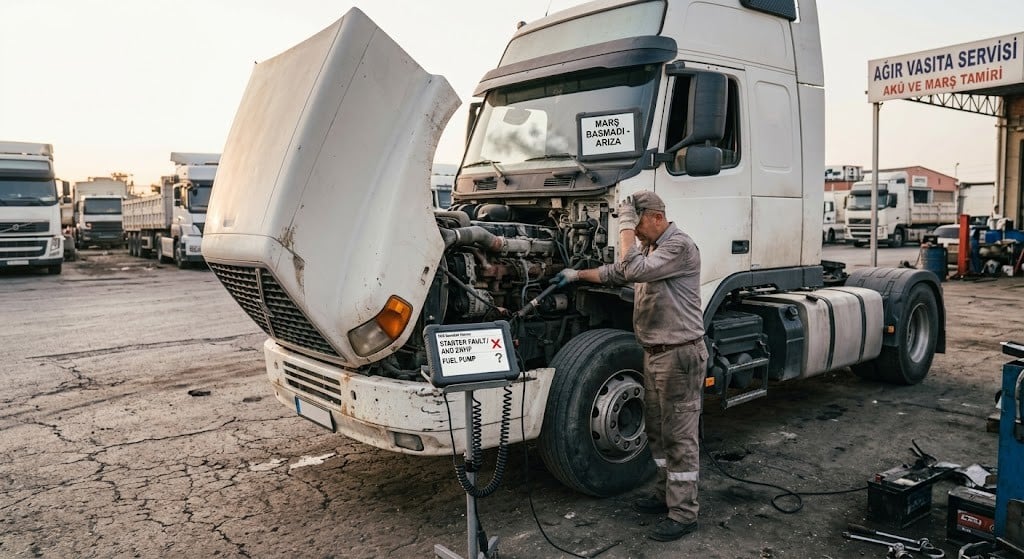
The Fuel Pump May Have a Pressure Problem
Fuel systems in modern diesel trucks operate with high precision.
If the fuel pump cannot generate the required pressure, the engine may be difficult to start.
Fuel pump problems may cause:
- Longer cranking time.
- The engine to start late.
- Reduced performance after starting.
- Irregular throttle response.
Measuring fuel pressure is important for identifying the source of the problem.
The Glow Plugs May Be Faulty
The glow system is particularly important in diesel engines during cold weather.
Glow plugs help the combustion chamber reach the appropriate temperature during the initial start.
When the glow system is faulty:
- Delayed starting in cold weather,
- White smoke,
- Starting after several attempts,
- Irregular operation during the first few minutes
may be observed.
Because the glow system in new-generation heavy-duty vehicles is electronically controlled, faults may also originate from sensors or the control module.
Engine Compression May Be Low
Inside the engine, the pistons, piston rings and cylinders generate a specific compression pressure.
When this compression value is low, diesel fuel becomes more difficult to ignite.
Causes of low compression may include:
- Piston ring wear,
- Cylinder wear,
- Valve leakage,
- Engine wear.
Compression problems are generally accompanied by the following symptoms:
- Persistent delayed starting,
- Performance loss,
- Oil burning,
- Exhaust smoke,
- Low power.
Sensor Faults May Cause Delayed Starting
In modern truck engines, the electronic control system receives information from many sensors in order to start and operate the engine.
In particular:
- Crankshaft sensor,
- Camshaft sensor,
- Fuel pressure sensor,
- Engine temperature sensor
faults may affect initial starting.
When incorrect information is received from the sensors, the ECU may:
- Change the fuel injection timing.
- Delay engine starting.
- Enter fault mode.
Does Cold Weather Cause a Truck to Start Late?
Yes. Low temperatures directly affect the initial starting performance of diesel engines.
In cold weather:
- Battery capacity decreases.
- Engine oil becomes more viscous.
- Fuel becomes more difficult to ignite.
- The glow system operates more intensively.
For this reason, delayed starting problems occur more frequently during winter.
However, a healthy truck engine should still start normally in cold weather when properly maintained.
What Checks Should Be Performed If a Truck Starts Late?
A systematic inspection should be carried out to identify the problem correctly.
Points that should be checked include:
- Battery voltage and capacity
- Starter motor performance
- Condition of the fuel filter
- Fuel pressure
- Injector values
- Air in the fuel line
- Glow system
- Engine sensors
- Compression values
Instead of focusing on only one component, the entire operating system should be evaluated.
What Should Be Done to Help a Truck Start on the First Attempt?
Regular maintenance can prevent most delayed starting problems.
Key points to consider include:
- Have the battery condition checked regularly.
- Replace fuel filters on time.
- Use high-quality fuel.
- Have the glow system checked before winter.
- Have the starter motor maintained.
- Check the fuel system for leaks.
- Use engine oil that meets the required standards.
- Pay attention to warning lights.
Especially in commercial vehicles, minor maintenance neglect may lead to larger faults and operational losses over time.
Frequently Asked Questions
Why is a truck difficult to start in the morning?
The most common causes of difficult morning starting are a weak battery, air entering the fuel system, glow system failure, a blocked fuel filter and low compression.
What is the cause if the starter cranks but the truck does not start?
If the starter motor operates but the engine does not fire, problems involving fuel pressure, injectors, sensors or the electronic control system should be investigated.
Why does a truck start late in cold weather?
In cold weather, battery performance decreases, engine oil becomes more viscous and diesel fuel becomes more difficult to ignite. The glow system also becomes more important during this process.
Why does a truck start late even though the battery is in good condition?
In addition to the battery, the fuel system, injectors, sensors, starter motor or engine compression may also cause delayed starting.
Does the fuel filter affect truck starting?
Yes. A blocked fuel filter may make initial starting difficult by preventing sufficient fuel from reaching the engine.
Does an injector fault cause delayed starting?
Yes. Faulty or contaminated injectors may disrupt fuel injection and cause the engine to start late.
What is the problem if a truck starts after several attempts?
This condition is generally associated with fuel pressure loss, air entering the fuel line, a weak battery or injector problems.
What should be done to help a truck start on the first attempt?
Regular maintenance should be performed, the fuel system should be inspected, the battery and starter system should be kept in good condition, and minor symptoms should be resolved before they develop into larger problems.
