


AdBlue Dosing Pump Crystallization in Heavy-Duty Vehicles and Cleaning Methods
In the heavy commercial vehicle sector, keeping international logistics, intercity haulage, excavation and heavy-tonnage transport running without interruption depends not only on the health of the engine's mechanical components, but also directly on the flawless operation of the exhaust emission control systems required by today's environmental standards. Selective Catalytic Reduction (SCR) systems, which are standard in heavy vehicles to meet Euro 4, Euro 5, Euro 6 and all later strict emission standards, are designed to convert the harmful nitrogen oxide (NOx) gases that diesel engines release into the environment into harmless nitrogen and water vapour. At the heart of this chemical reaction is AdBlue, a urea-based aqueous solution made up of 32.5% high-purity urea and 67.5% deionised water. The most sensitive, critical and also most failure-prone component of the SCR system is the AdBlue dosing pump (the pump cylinder or pump unit), which delivers the AdBlue in the tank to the injector in the exhaust line at precise pressure and flow. However, one of the biggest chronic problems arising from the chemical nature of AdBlue, temperature changes and storage quality is crystallization (urea deposit formation). These white crystal masses that build up inside the dosing pump or in the lines upset the pressure balance of the system, causing torque loss in trucks, loss of pull in the engine (limp mode) and exhaust fault lamps to light up.
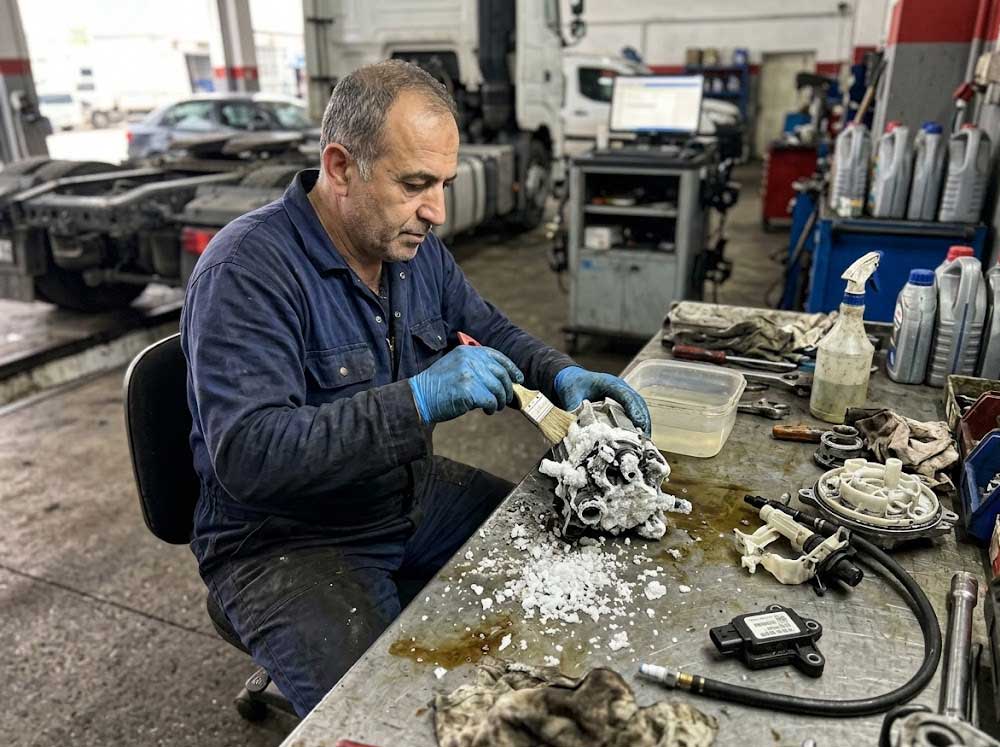
The Critical Role and Operating Principle of the AdBlue Dosing Pump in the SCR System
In the SCR system integrated into the exhaust silencer group of heavy commercial vehicles, the dosing pump module (generally known as the pump cylinder or electronic pump body) works on signals it receives from the brain of the system. The engine control unit (ECU) continuously analyses exhaust gas temperature, engine load and instantaneous NOx emission through sensors. Based on this data, it sends a command to the dosing pump to inject the right amount of AdBlue for the exhaust gas flow. The pumped fluid reaches the dosing injector through special heated lines and is sprayed into the exhaust gas as a mist (atomisation). Meeting the high exhaust temperature, the water in the AdBlue evaporates and the urea molecules turn into ammonia (NH3) gas, which reaches the SCR catalyst inside the catalytic converter. There, the harmful NOx gases react with the ammonia and are broken down into completely harmless nitrogen and water.
Inside the dosing pump there are micron-precision solenoid valves, pressure sensors and internal filters so that pressure can be adjusted precisely. Even when the system stops and the ignition is switched off, smart pump modules put the line through a purge (reverse suction) cycle and draw the fluid in the pipes back into the tank so that residual heat in the exhaust line cannot damage the pump and lines. However, when this mechanism is interrupted over time by various factors, chemical crystallization in the delicate internals of the dosing pump becomes unavoidable.
Why Does Crystallization (Urea Deposit Formation) Occur in the AdBlue Dosing Pump?
AdBlue is a fairly stable chemical composition at room temperature, but when it is exposed to certain physical and chemical conditions, the conversion of urea into solid crystal form as the water evaporates is unavoidable by nature. The main technical factors that trigger dosing pump crystallization in heavy vehicles are as follows:
- Use of Low-Quality or Non-Standard AdBlue: Poor-quality AdBlue on the market that does not comply with ISO 22241, is made in backyard operations or is prepared with tap water instead of pure water contains excessive minerals and foreign particles. These foreign substances act as nuclei during temperature changes inside the dosing pump and start very rapid and dense crystallization.
- Purge (Reverse Suction) Cycle Interrupted After Ignition Off: If the vehicle is switched off abruptly at the master switch or a power cut occurs, the pump unit cannot finish drawing the AdBlue remaining in the lines back into the tank. The fluid left in the lines and the pump chamber evaporates quickly from the residual heat coming from the exhaust, crystallizes and blocks the solenoid valve seats.
- Extreme Temperature Changes and Exhaust Heat Stress: In some heavy vehicle models where the dosing pump is positioned very close to the exhaust silencer or the engine block, high ambient temperatures in summer and radiant heat from heavy road conditions instantly evaporate the water of the fluid left in the pump and leave solid urea crystals behind.
- Long Periods of Standing Idle: In heavy vehicles left standing for weeks in a garage or on a construction site, even the smallest fluid residue inside the pump comes into contact with air and crystallizes over time, causing the mechanism to jam when the engine is first started.
Symptoms and Fault Codes of Dosing Pump Crystallization on the Vehicle
Although the crystallization process that begins in the AdBlue dosing pump progresses silently in its early stages, as soon as the pressure tolerances inside the pump are upset it shows itself in the vehicle through clear performance losses and warnings. The main symptoms drivers and service technicians encounter are as follows:
- SCR and Emission Warnings on the Instrument Cluster: Warning messages such as "AdBlue System Fault", "SCR Efficiency Low" or "Dosing Malfunction" appear on the digital display; the malfunction indicator lamp (MIL) and the yellow/red SCR warning lamps light up.
- Torque Limitation (Limp Mode) and Power Loss: When the SCR system is disabled or the dosing pump reports a pressure fault, the emission software of modern heavy vehicle engines puts the vehicle into torque limitation as a legal requirement. The vehicle loses pull on slopes, does not respond to the throttle and cannot exceed a certain maximum speed (for example 20 km/h or 50 km/h).
- Pressure and Valve Codes on the Diagnostic Tool: When connected to the system with authorised diagnostic tools (for example Volvo Tech Tool, Wabco, Knorr-Bremse or Bosch diagnostics), fault codes such as "AdBlue Dosing Pressure Too Low", "Dosing Valve Stuck Closed" or "Line Blocked by Crystallization" are read.
- Visible White Powder and Crusting: Slightly yellowish or bright white, salt-like hard crystal crusts become visible on the outer body of the pump module, at the fitting connection points and around the electrical sockets.
Methods for Cleaning Dosing Pump Crystallization and Professional Decontamination Steps
To repair a dosing pump that is blocked by AdBlue crystallization or is suffering a pressure drop, the right cleaning methods must be applied. Wrong interventions can cause permanent damage to the pump's electronic board and delicate solenoid valves. The professional cleaning stages applied are as follows:
- Chemical Dissolving with Hot Water (Ultrasonic Washing): Urea crystals are highly soluble in water, but pure water at room temperature alone may be insufficient to remove hardened deposits. The dosing pump is mechanically removed and disassembled; the metal and plastic components are soaked in special urea-dissolving chemical solutions or warm water baths. With ultrasonic washing equipment, the crystals in microscopic channels are broken up by vibration energy.
- Channel Cleaning with Compressed Air: After the chemical dissolving process is complete, all the channels and solenoid valve seats inside the pump are dried with clean low-pressure air so that all residue is blown out. High-pressure air must never be used, otherwise the internal diaphragms may tear.
- Renewing the O-Ring and Seal Sets: During crystallization cleaning, the rubber O-rings and seal sets that provide the pump's internal sealing have usually lost their elasticity during disassembly and must be renewed with original repair kits.
- Protecting the Electronic Board and Sockets: During cleaning, acidic, thinner-based or abrasive chemicals must not be used under any circumstances; otherwise the integrated electronic circuit board (ECU) on the pump may burn out.
Methods for Preventing Crystallization, Correct Operating Discipline and the Mesay Otomotiv Guarantee
To prevent AdBlue dosing pump failures and crystallization costs in heavy vehicle fleets, a proactive maintenance discipline is essential. The vehicle's AdBlue tank should always be filled with certified original fluids that comply with the ISO 22241 standard, and attention should be paid to the cleanliness of storage containers. Before the ignition is switched off, you should wait a few seconds for the system to complete the purge (reverse suction) process, and the master switch should not be cut early. Particularly in winter, vehicles should be parked under suitable conditions to protect the AdBlue system against freezing, and the anti-freeze systems should be kept active.
In line with our decades of technical experience in heavy commercial vehicle transmissions, differentials and driveline components and our rich stock infrastructure, we offer reliable solutions for the SCR emission systems, AdBlue dosing pumps, injectors and original repair kits of all leading heavy vehicle groups such as MAN, Mercedes-Benz, Scania, Volvo, Ford Cargo and Renault. To guarantee that your fleet fully complies with exhaust emission standards and does not lose time and money on the road because of torque loss (limp mode), we continue to be the most reliable partner of your workshops with all the original spare parts and technical support solutions you need.
