


How Does a Differential Lock Work? Diff Lock Failures in Construction Site Trucks
Construction trucks in 6x4, 8x4 or 4x4 configurations, working on heavy construction sites, in mines, excavation areas and on highway projects, constantly battle mud, slippery ground, steep climbs and rough terrain. Transferring the enormous torque applied to the axles of these heavy commercial vehicles to the ground without loss is vital to keeping operations running without interruption while they haul tonnes of rubble, rock or ready-mix concrete. The conventional open differentials in the driveline of heavy-duty vehicles allow the left and right wheels to turn at different speeds in corners, which prevents tyre wear and axle breakage; but when one wheel sinks into mud or lifts off the ground, the vehicle is left completely immobile. The most critical mechanism that eliminates this natural weakness of the open differential and lets construction trucks climb out of even the toughest terrain is the differential lock (diff lock) system. However, diff lock mechanisms that work under constant high mechanical stress, suffer driver misuse or are poorly maintained can, over time, lead to serious breakages and costly gearbox and axle failures.
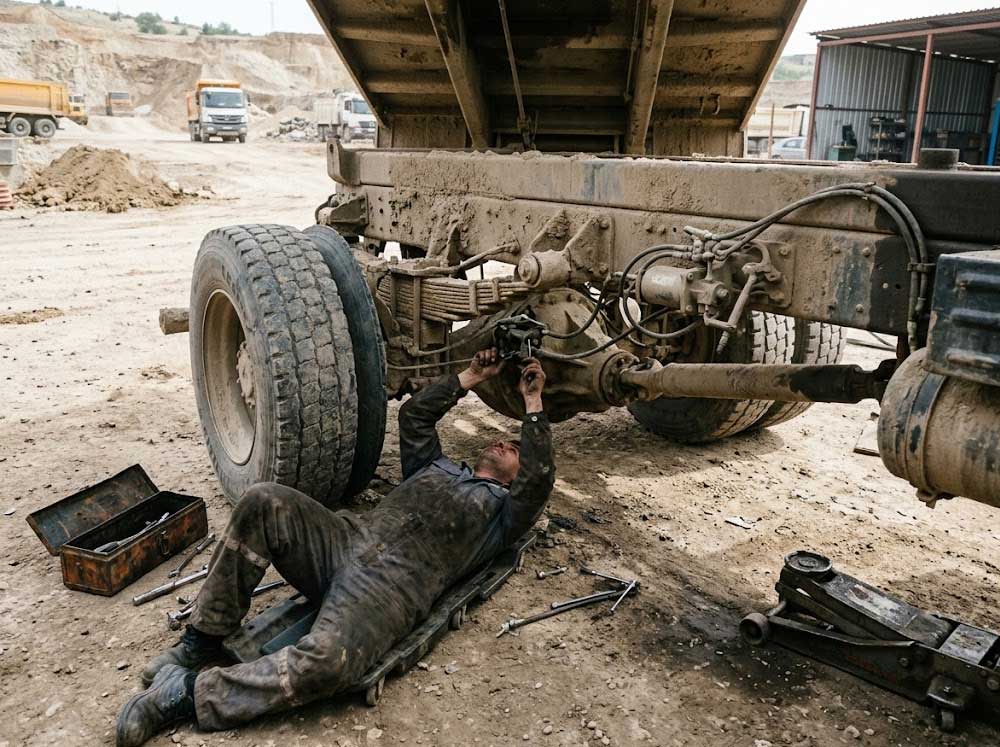
How the Standard Open Differential Works and the Vital Role of the Differential Lock in Tough Construction Site Conditions
In heavy commercial vehicles, the rotation coming from the gearbox and driveshaft is turned through 90 degrees by the pinion and the ring gear inside the differential housing and delivered to the left and right axle shafts. In a standard open differential, the spider gears (pinions) and side gears sit inside the carrier attached to the ring gear. When the vehicle travels in a straight line, the spider gears do not rotate on their own axes and power is delivered equally to both axle shafts. When the vehicle enters a bend, the outer wheel has to cover a longer distance, so the spider gears begin to rotate, allowing the inner wheel to turn more slowly and the outer wheel more quickly.
However, the basic physics of the open differential contains a very important rule: the system always sends torque to the wheel with the least resistance. When the right wheel of a heavy-tonnage dump truck sinks into a deep mud hole or spins freely in loose soil, the friction between that wheel and the ground approaches zero. In this case the open differential sends all the torque to the spinning wheel, while the wheel on firm ground receives no power at all and the vehicle stays stuck where it is. This is where the differential lock mechanism (diff lock) comes in: by locking the independent rotation of the spider gears, or by mechanically coupling the left and right axle shafts together, it equalises the torque delivered to both wheels (50% - 50%). The wheel on firm ground then receives full torque and pulls the massive truck out of the mud or the steep ramp pit.
Internal Structure and Engagement Mechanism of Pneumatic and Electro-Mechanical Differential Lock Systems
The differential lock mechanisms used in construction trucks are generally controlled by pneumatic (air-operated) or electro-pneumatic systems. At the heart of the lock mechanism, which is activated by a driver's switch or rotary switch in the cab, are the dog clutch, the shifting sleeve, the pneumatic cylinder and the lock fork.
When the driver presses the switch, a solenoid valve fed from the vehicle's main pneumatic air line opens and sends compressed air to the pneumatic piston mounted on the differential housing. Moved by air pressure, the piston pushes the lock fork, which slides the dog clutch sleeve along the splines on the axle shaft. The dog clutch engages with the differential housing or the spider gear carrier and makes the axle shaft and the differential body act as a single piece, as if bolted together. The moment mechanical locking is achieved, the spider gears are completely prevented from rotating on their own axes. Construction trucks can have two different lock levels: a cross-axle differential lock (connecting the left and right wheels) and a longitudinal / inter-axle differential lock (connecting the front and rear drive axles on 6x4 or 8x4 tandem-drive vehicles).
Common Differential Lock Failures, Operating Errors and Causes of Wear in Construction Site Trucks
Although differential lock mechanisms are manufactured from extremely robust metallurgical alloys by design, they often fail because of the harsh conditions of the construction site and, in particular, operating errors caused by the human factor. The most common diff lock failures seen in the field and their causes are as follows:
- Engaging the Lock While the Wheels Are Spinning (During Wheelspin): This is the deadliest driver error. When the vehicle is stuck in mud and one wheel is spinning at high speed, engaging the differential lock makes the stationary axle shaft and the fast-rotating lock dogs collide with tremendous impact force. This causes the dog clutch teeth to break instantly, the lock fork to bend and a storm of metal chips to be released inside the differential housing.
- Driving in Locked Mode on Hard, Dry Ground (Asphalt): The differential lock should be used only on slippery or loose ground. When you try to turn a corner on hard asphalt or dry concrete with the lock engaged, the left and right wheels want to turn at different speeds but cannot because of the lock. This creates enormous torsional stress on the axle shafts, spider gears and lock dogs; as a result the axle shaft breaks or the lock mechanism blows apart.
- Pneumatic Cylinder and Air Leak Failures: Wear of the O-rings and seals of the pneumatic piston that pushes the differential lock, together with moisture and oil deposits in the air, leaves the lock fork stuck halfway. A dog clutch sleeve that does not seat fully skips teeth under load, stripping the lock dogs and preventing the system from engaging.
- Lock Signal Switch and Electrical Wiring Faults: Oxidation of the pressure/position switches that tell the driver in the cab that the lock has engaged, caused by mud, water and impact, or broken wires, leave the driver unable to tell whether the lock is on or off and set the stage for incorrect use.
Damage to the Housing, Spider Gears and Axle Shafts Caused by Misuse and a Faulty Lock Mechanism
A small fracture or broken dog in the differential lock mechanism, if not noticed and dealt with in time, leads to the scrapping of the entire differential assembly. Broken metal dog fragments or fork burrs begin to circulate freely in the differential oil. These hard metal pieces, which get between the crown-pinion gears turning under massive load, break the ring gear teeth, destroy the spider gear bearings and scratch the inner surface of the housing.
In addition, the unbalanced torsional loads placed on the axle shafts by incomplete or only half-engaged differential locks cause the axle shaft splines to strip or the axle to twist and snap right through the middle. In construction trucks that are driven at high speed with the lock engaged by mistake, the differential oil temperature reaches extreme levels and destroys the lubricating properties of the oil; this causes severe damage ranging from seized differential bearings to a bent axle housing.
Differential Lock Maintenance in Construction Vehicles, Correct Operating Discipline and Mesay Otomotiv Spare Part Solutions
To prevent differential lock failures in construction trucks and avoid high overhaul costs, great importance must be given to both driver training and periodic maintenance discipline. Drivers should be made aware that the differential lock must never be engaged until the vehicle has come to a complete stop or the wheel slip has stopped. The lock should be switched off immediately after the vehicle gets out of the mud or difficult ground, and it should be confirmed that the lock indicator lamp has gone out. During periodic maintenance, the differential oil level and quality should be checked, and the magnets on the sump plugs should be inspected at oil changes to detect any burrs or metal particles early. In addition, the vehicle's air dryer filter should be replaced regularly so that water and oil do not reach the pneumatic lock cylinders.
With decades of technical experience and a rich stock infrastructure in the field of heavy commercial vehicle transmissions, differentials and driveline components, Mesay Otomotiv offers original-equipment-standard spare part solutions for the differential lock mechanisms, dog clutch sleeves, lock forks, spider gear carriers, axle shafts and pneumatic cylinder repair kits of all leading construction truck groups such as MAN, Mercedes-Benz, Scania, Volvo, Ford Cargo and Renault. To keep your fleet transferring torque without interruption on the road and in the field under tough construction conditions, to prevent axle breakages and to maximise operational efficiency, we continue to be the most reliable partner of your workshops with our expert team and fast logistics network.
