


Driveshaft U-Joint Failure in Trucks: Causes of Vibration While Driving
The uninterrupted and safe operation of international transport, logistics, construction and heavy-tonnage freight depends directly on the high mechanical strength and flawless synchronization of the driveline components of heavy commercial vehicles. Trucks and tractor-trailers carrying enormous loads on Turkish highways and international long-haul routes rely on a highly complex transmission mechanism to deliver the high torque produced by the engine to the wheels. One of the most strategic links in this chain, and one directly exposed to mechanical load, is the driveshaft, known technically as the cardan shaft. This system takes the rotational motion from the transmission output shaft and passes it to the differential pinion gear, and it must adapt to suspension movement and changes in axle height. The most critical component that gives the driveshaft this angular flexibility is the driveshaft U-joint (universal joint cross) located at the joint points (cardan joint spiders). Working for hundreds of thousands of kilometers under tons of load, at constantly changing speed ratios and in harsh road conditions, U-joints can wear out and fail over time because of friction and metal fatigue. A U-joint that develops play or breaks apart is no longer a simple part failure: it becomes the root cause of severe vibrations felt in the cab while driving, dangerous driveline separations and costly transmission and differential damage.
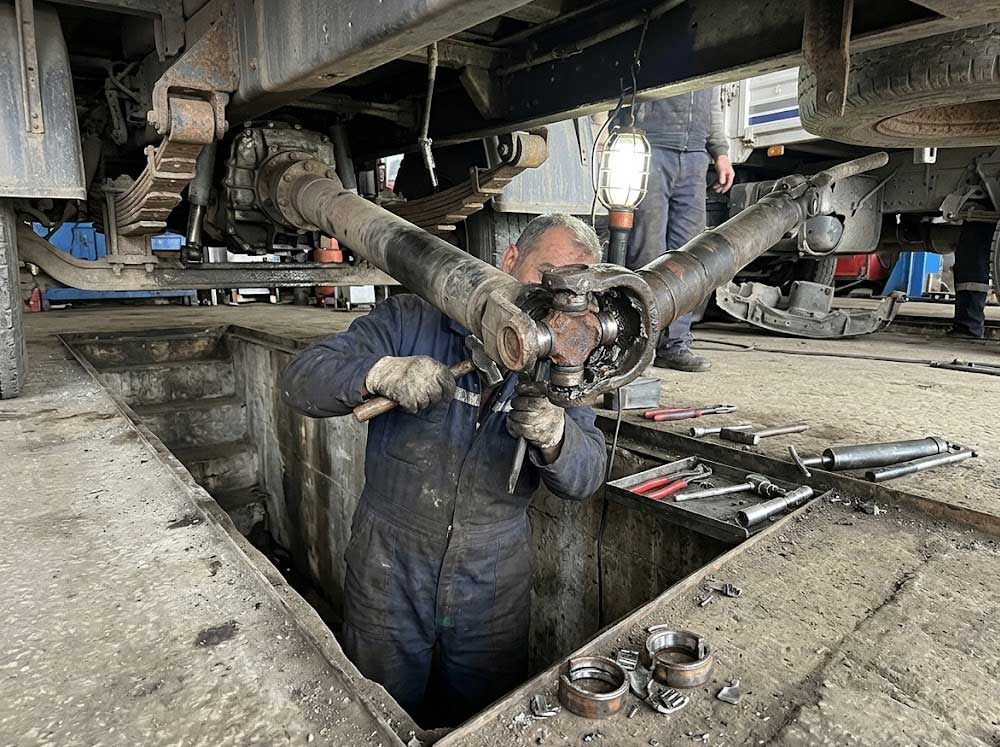
The Critical Function of the Driveshaft (Cardan Shaft) and U-Joint in Heavy-Duty Drivelines
In heavy vehicle architecture the engine and transmission sit in a fixed plane on the chassis, while the rear drive axles constantly oscillate vertically because of suspension travel, leaf spring flex and road irregularities. The mechanism that compensates this angular and distance difference between the transmission output and the differential input with millimetric flexibility is the cardan shaft. The U-joints located at both ends of the shaft or at the intermediate bearing support points keep the angular flexibility between two independent shafts while transmitting rotation without loss. A U-joint consists of a cross-shaped forged steel spider, the needle roller bearing cups seated on its four axes, rubber seals and retaining snap rings. Tolerating millisecond-level angle changes while rotating under high torque, this mechanism carries the axial and radial loads generated during rotation. When U-joints work with perfect mass balance and a proper lubrication film, the centrifugal force of the shaft approaches zero; however, even micron-level wear in the needle rollers upsets the mass balance of the system and produces vibration waves that spread through the entire vehicle.
What Causes Vibration While Driving? Stage-by-Stage Development of U-Joint Failure
Worn driveshaft U-joint bearings are among the most common and insidious sources of vibration felt while driving trucks and tractor-trailers. Because the driveshaft is a huge tube spinning at high speed, even the slightest axial displacement creates a large dynamic imbalance. When the needle rollers inside the U-joint cups start to wear, mechanical play appears between the spider and the cup. Once the vehicle reaches a certain speed range (usually 50-80 km/h), the loose U-joint makes the cardan shaft deviate from its own axis of rotation and start to wobble. This wobble is transmitted directly to the chassis, the cab floor and the gear lever as high-frequency vibration. Drivers often confuse this with wheel imbalance; however, driveshaft-related vibrations tend to intensify when the accelerator is pressed or under load, and to change character when the gearbox is put in neutral. Light vibrations that are not addressed in time crush the needle rollers in the U-joint cup further with every kilometer, enlarging the play and eventually leading the joint to seize completely and break apart.
Main Causes of U-Joint Breakdown and Wear
The leading technical factor that causes driveshaft U-joints in heavy commercial vehicles to fail before their service life or to shatter suddenly is neglected periodic greasing. U-joints operate under extremely high surface pressures. If pressure-resistant special grease is not pumped in through the grease nipple on the spider at periodic maintenance intervals, the needle rollers inside the cup run dry, overheat and fail in a short time. Another important factor is overloading, sudden launches and harsh retarder use. In vehicles carrying tonnage above legal limits, launch shocks caused by suddenly releasing the clutch or heavy retarder braking multiply the torque on the cardan shaft instantly, causing the needle rollers to embed in the cup walls.
In addition, loss of driveshaft balance and external impacts directly consume U-joint life. In trucks working on construction sites or in excavation environments, if a stone hits the shaft tube or balance weights break off, the cardan shaft loses its center and applies unbalanced radial forces to the U-joints. Aged or collapsed transmission rear mounts or differential suspension lugs distort the factory working angle of the cardan shaft. U-joints forced to operate bent beyond their angular limits overheat and seize in a short time. Finally, if a pressure washer is aimed directly at the U-joint seals or the vehicle passes through muddy water, water entering through the seals washes out the grease and starts corrosion and rust.
Early Warning Signs and Acoustic Indicators of U-Joint Failure for Drivers and Technical Service
Before driveshaft U-joints break down completely and cause a catastrophe, they give very clear warnings through the vehicle mechanics. A distinct metallic “clunk” or “thud” from under the vehicle when a stationary truck or tractor-trailer first moves off, or when a gear is shifted and the clutch released, is the clearest proof that dangerous play has developed in the U-joint cups. When the grease in the cups runs out or the needle rollers fall apart, direct metal-to-metal friction produces a high-pitched squeal and ringing sound that is clearly audible especially at low speeds with the window open. If these sounds are accompanied by vibration waves that increase in proportion to vehicle speed and create a noticeable tingling in the seats, the steering wheel and especially the cab floor, the driveshaft joint has lost its center.
Worst-Case Damage from a Broken Driveshaft: Transmission Tail Housing, Differential Pinion and Accident Risks
A driveshaft U-joint shattering completely while driving and the joint separating is one of the most dangerous failure scenarios in heavy vehicle transport. When a cardan shaft spinning at high speed is freed at one end, it starts to pound the floor of the truck or tractor-trailer like a giant whip. The uncontrollably flailing shaft tube breaks the transmission tail housing it is attached to, the main transmission body or the differential pinion nose, causing oil to spill onto the road. This results in massive damage worth tens of thousands of euros, requiring replacement of the complete transmission and differential. The flailing of the shaft can also tear air hoses and wiring harnesses on the chassis, which can lock up the vehicle's braking system. If the free end of a shaft that has broken off at the front joint digs into the asphalt beneath a vehicle traveling at high speed, the multi-ton tractor-trailer can be lifted into the air and roll over, causing a chain-reaction accident.
Driveshaft Balancing (Dynamic Balance) and Technical Tolerances to Observe When Replacing U-Joints
Replacement of a faulty driveshaft U-joint must be carried out to professional service standards. When removing the cups and pressing new cups into the bores, a hammer must never be used; a hydraulic press and special pullers must be employed. Hammer blows crush the delicate needle rollers inside the newly fitted cup and spoil the fit. After the new U-joint installation is completed, it must be verified that the retaining snap rings are fully seated in their grooves. After assembly, the cardan shaft must be placed on a high-speed dynamic driveshaft balancing machine, and the precisely measured imbalance must be eliminated by welding special balance plates onto the shaft tube. A driveshaft fitted to the vehicle without balancing will quickly ruin the new U-joint as well.
Long-Life Power Transmission for Logistics Fleets, Choosing the Right Spare Parts and the Mesay Otomotiv Guarantee
For heavy commercial vehicle fleets, operational continuity and minimum maintenance cost are the most fundamental business goals. Choosing cheap aftermarket U-joints when selecting parts for the driveshaft and driveline exposes fleets to major financial risks. U-joints manufactured to original equipment manufacturer (OEM) standards, subjected to special induction heat treatment and fitted with high-temperature-resistant seals should be preferred.
With decades of deep technical experience and strong stock capacity in heavy commercial vehicle transmissions, differentials and driveline components, Mesay Otomotiv supplies the industry with driveshaft U-joints, cardan joint kits, driveshaft hanger bearings and flange groups for all leading heavy vehicle brands such as MAN, Mercedes-Benz, Scania, Volvo, Ford Cargo, Iveco and Renault, to high quality standards. To keep your fleet running safely on the roads and prevent unexpected breakdown costs, we continue to be your most reliable business partner with our fast logistics network and expert technical team.
