


What Happens When the EGR Valve Stays Open? Black Smoke and Engine Shaking Causes
The uninterrupted operation of international logistics, intercity freight, excavation and heavy-tonnage transport in the heavy commercial vehicle sector depends directly on the engine, the heart of the vehicle, working in perfect harmony with the exhaust emission control systems. One of the most critical components developed to keep nitrogen oxide (NOx) emissions below legal limits in modern diesel engines is the EGR (Exhaust Gas Recirculation) valve. By redirecting part of the burnt gases leaving the exhaust manifold back into the intake manifold, this valve lowers in-cylinder combustion temperature and acts as the bridge that lets the engine comply with environmental standards. However, because of heavy operating conditions, fuel quality and soot buildup, the EGR valve can occasionally get stuck in the open position. An EGR valve that stays open prevents the engine from taking in fresh air, and is among the chronic faults that lead to dense black smoke from the exhaust, severe engine shaking at idle, reduced turbo efficiency and serious torque loss in the vehicle.
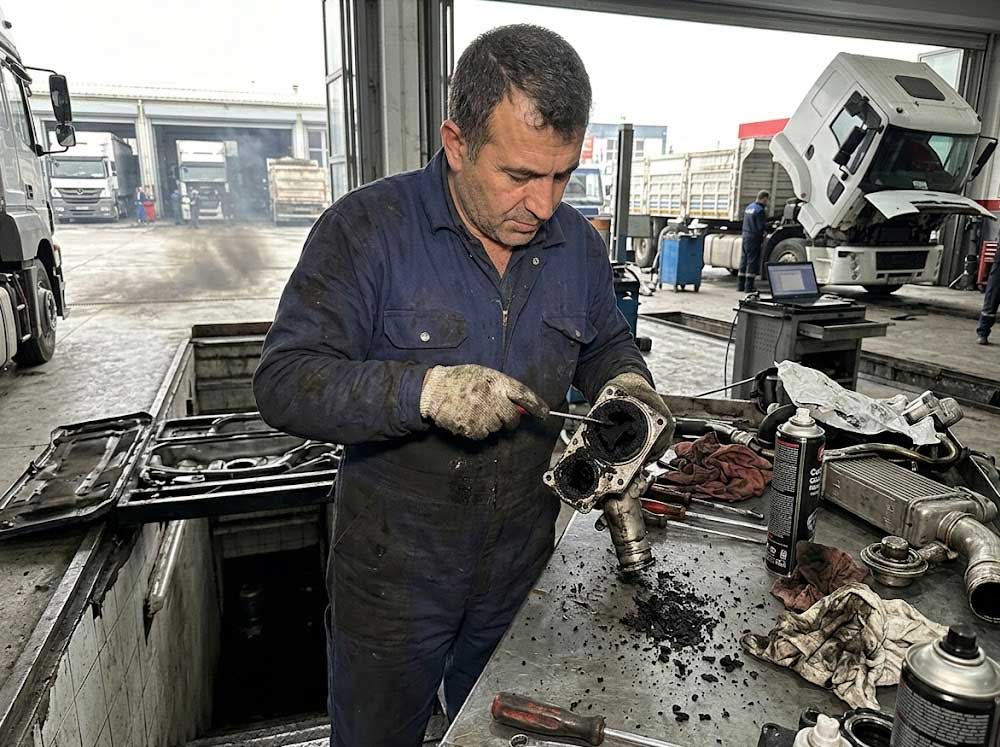
Normal Operating Principle of the EGR Valve and Its Role in the Engine Management System
The basic purpose of the EGR valve in diesel engines is to optimize the temperature in the combustion chamber and prevent the formation of toxic NOx gases. When the engine runs at low and medium speeds under light load, the engine control unit (ECU) opens the EGR valve by a certain percentage. Hot, inert (burnt) exhaust gas taken from the exhaust manifold outlet passes through the EGR cooler, is fed into the intake manifold and mixes with the fresh air. When this mixture with a lower oxygen ratio enters the cylinder, the peak temperature at the moment of combustion drops, and harmful NOx emissions are greatly reduced. When the engine demands sudden acceleration (kick-down) or runs at high speed under full load, the ECU closes the EGR valve completely; the cylinder then fills with pure, oxygen-rich fresh air, delivering maximum engine power and torque. The opening and closing cycles of the EGR valve are managed with millisecond timing by the engine's electronic brain and the sensitive electro-pneumatic or stepper-motor actuators on the valve.
Why Does the EGR Valve Stay OPEN? Soot Blockage and Mechanical Sticking Causes
The biggest enemy behind an EGR valve getting stuck in the open position in heavy vehicles is the carbon soot and unburnt oil vapor produced by diesel combustion. The main technical factors that keep the EGR valve open in trucks and tractor-trailers that cover hundreds of thousands of kilometers are as follows:
- Heavy Soot and Tar Buildup: With low-quality fuel, stop-and-go idling in city traffic or a turbo oil leak, heavy carbon particles in the exhaust gas stick to the mechanical stem and seat of the EGR valve and form a thick layer of soot. Over time this layer prevents the valve from closing.
- Actuator and Mechanical Spring Failures: Stripped gears on the electric stepper motor that opens and closes the EGR valve, a solenoid valve coil failure or a broken internal spring leave the valve hanging in the open position despite the command it receives.
- Soot-Related Valve Seat Deformation: Hard carbon deposits that build up on the seat where the valve head sits physically prevent the valve from seating fully and sealing, so the valve stays slightly open all the time.
Symptoms Occurring in the Engine and Exhaust When the EGR Valve Stays Open
An EGR valve stuck in the open position completely upsets the breathing balance of the diesel engine. The clearest fault symptoms drivers and service technicians encounter in the field are as follows:
- Heavy Black Smoke: When the EGR valve stays open, the cylinders are constantly filled with oxygen-depleted exhaust gas instead of the pure, fresh oxygen needed for combustion. This prevents complete combustion of the fuel (the injected diesel cannot mix ideally with air); as a result, tar-colored dense black smoke begins to come out of the exhaust.
- Severe Engine Shaking and Fluctuation at Idle: Exhaust gas, which should never enter the engine at idle, constantly filling the cylinders makes engine speed unstable and causes idle vibration, shaking and even stalling.
- Turbo Lag and Torque Loss (Serious Loss of Pulling Power): When the vehicle climbs a hill or tries to accelerate, turbo pressure must rise; but an open EGR valve lets boost pressure escape into the exhaust before it fills the intake manifold, or makes pressure drop. The truck goes weak on slopes, does not respond to the throttle and the engine enters limp mode.
- Warning Lights on the Instrument Panel: The ECU detects the mismatch between data from the mass air flow (MAF) sensor and the exhaust pressure sensors, turns on the engine warning light on the instrument panel and stores the “EGR Flow Malfunction” fault code.
Damage Caused by an EGR Valve Fault to Cylinder Heads, the Turbo and Fuel Injectors
If the open EGR valve problem is ignored for a long time, it sets the stage for chain-reaction and very expensive mechanical damage in the engine. Cylinders constantly running on insufficient oxygen and a rich mixture suffer combustion chamber temperature imbalances. Unburnt fuel particles (soot) wash away the oil film on the cylinder walls and cause premature wear of the piston rings and liners. High-temperature soot escaping in reverse from the exhaust manifold to the intake manifold wears the exhaust turbine blades of the turbocharger and completely clogs the intercooler cores. In addition, because of poor combustion, injector nozzles quickly coke up and lose their spray angle, which leads the engine into an irreparable drop in performance.
Cleaning Methods, Replacement Criteria and the Mesay Otomotiv Guarantee
In the first stage of EGR valve faults, the valve can be removed and cleaned of hard soot layers with special solvent-based chemical cleaners and ultrasonic washing equipment. However, cleaning offers only a temporary solution for EGR valves with a broken mechanical spring, a burnt stepper motor or a deeply worn valve seat; in such cases the valve must be replaced with a new unit of original equipment (OEM) quality. Performing adaptation and calibration through the vehicle's ECU after EGR replacement is critically important for stable engine operation.
With our decades of technical experience in heavy commercial vehicle transmissions, differentials, engines and driveline components and our strong stock infrastructure, we supply the industry with genuine EGR valves, EGR coolers and emission system spare parts for all leading heavy vehicle groups such as MAN, Mercedes-Benz, Scania, Volvo, Ford Cargo, Iveco and Renault. To make sure your fleet does not lose time to black smoke problems on the road, that engine torque performance stays at day-one level and that high operational efficiency is achieved, we continue to be your most reliable business partner with our wide product range and fast logistics network.
