


How to Tell When a Wheel Hub Bearing Is Failing: Overheating and Humming Symptoms
Wheel hub bearings are among the most critical running-gear components determining the operational safety, driving dynamics and road-holding ability of international logistics fleets, long-haul freight carriers, earthmoving transport and heavy commercial vehicles carrying tons of cargo. On trucks, semi-trailer tractors, buses and tow units covering thousands of kilometers, from Turkish highways to Europe's demanding mountain routes, wheel hub bearings are high-strength mechanical bearings that transfer tons of weight to the wheels and let the wheel rotate on the stub axle without friction. In the axle architectures of leading heavy-vehicle brands such as Mercedes-Benz, Ford F-Max, Scania, Volvo, MAN, Iveco and Renault, hub bearings are exposed to enormous radial and axial forces. However, heavy tonnage, rough construction-site roads, insufficient grease lubrication, and water and dust entering through damaged wheel seals wear the bearings over time, create play in the rolling elements and eventually cause them to seize and disintegrate. A collapsed wheel hub bearing is an extremely dangerous failure that can cause the wheel to come off, the axle to lock, brake discs to be destroyed and traffic accidents with severe material and human damage. In commercial fleet operations this threatens lives and also leads to costly repair losses.
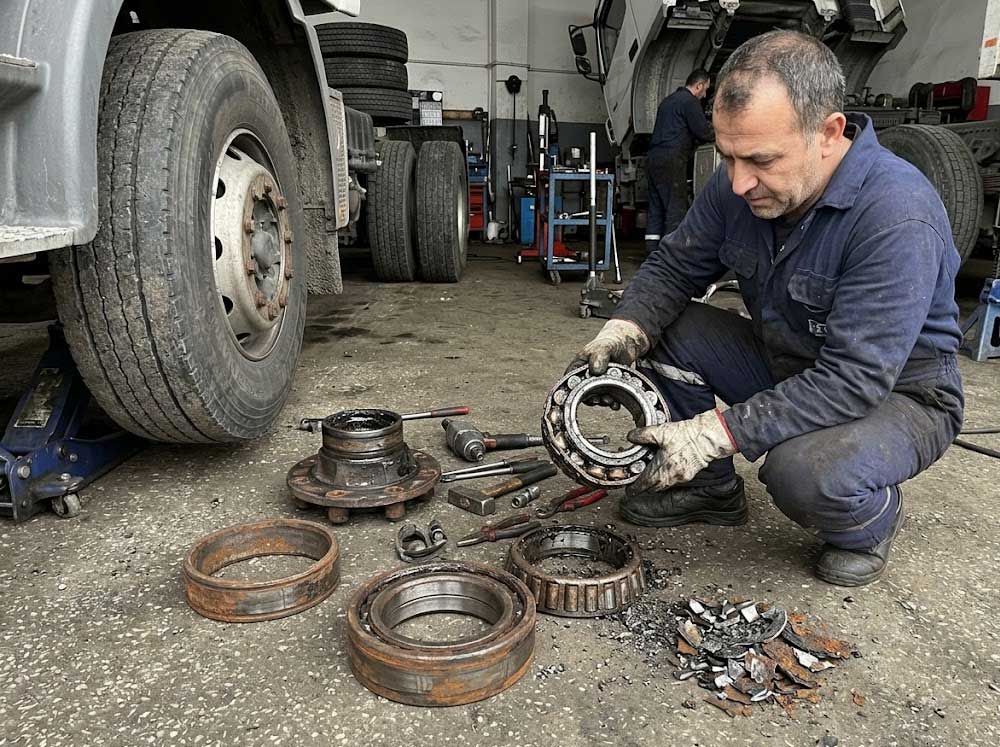
The Working Mechanics of the Hub Bearing and Its Critical Role in the Running Gear
On heavy commercial vehicles, the hub bearing is a system of tapered or spherical roller elements made from special high-carbon steel, located between the wheel hub and the fixed axle stub. While the vehicle is moving, tons of weight rest on the rotating elements of these bearings; while carrying this enormous load, they let the wheel turn with minimum friction. Friction heat is kept under control by the special high-temperature-resistant grease inside. In heavy-tonnage transport, however, the axial loads on the outer wheels during cornering and the impact forces from speed bumps create microscopic deformations in the bearing seats. When the seals lose their effectiveness over time, water, mud and dust get inside, degrade the grease, let metal surfaces rub directly against each other and set the stage for rapid bearing deterioration.
The loads on hub bearings are not limited to static weight. During dynamic driving, braking forces, pothole impacts from the road and the resistance created by crosswinds are all transmitted directly through these bearings. For this reason, the quality of the bearing steel and its heat-treated structure are carefully engineered so that the bearing can complete millions of revolutions over thousands of kilometers.
Early Symptoms of Hub Bearing Failure and Wear
A wheel hub bearing does not collapse suddenly; beforehand it sends very clear acoustic and physical warning signals to the driver and maintenance staff. Noticing these symptoms in time is vital to prevent breakdowns on the road and accidents:
- Humming and Growling Noise from the Wheel: A growling sound from the wheel area at highway speeds, resembling a jet engine hum, whose frequency and pitch rise with speed, is the clearest sign that the hub bearing is wearing out. A change in the noise while cornering reveals the location of the fault (if the noise grows when turning right, the left bearing is faulty; if it grows when turning left, the right bearing is faulty).
- Excessive Heat at the Rim and Hub Area: If, when checked by hand after driving, the hub center and rim center are much hotter than the other wheels, this shows that friction and wear inside the bearing have reached their peak.
- Steering Vibration and Play: Excessive play in front axle hub bearings causes vibration in the steering wheel, slight looseness and wandering of the vehicle on the road.
- Drum or Disc Rubbing Noises: Because of play in the bearing, the wheel hub moves off its axis; this makes the brake disc rub against the caliper carrier or the pads and produce metallic squeals.
Dangerous Consequences That Bearing Overheating and Lockup Can Cause
If the humming and overheating symptoms of the hub bearing are ignored and the trip continues, the balls or rollers inside the bearing jam and fracture because of excessive heat. Bearing lockup or complete collapse triggers the following disaster scenarios:
- Axle Fracture and Wheel Separation: A locked hub subjects the axle shaft to a sudden torsional force, causing the axle to shear and the wheel to separate completely from the vehicle.
- Brake System Failure: Fragments of the collapsing bearing crush the brake disc, ABS sensors and calipers and disable the brake system instantly.
- Fire Risk: Excessive friction and heat can ignite the grease inside the hub and cause a major fire in the wheel area.
Professional Fault Diagnosis Methods and Inspection Steps
To detect a hub bearing fault on heavy vehicles, the vehicle is lifted with a jack and a wheel play test is carried out. If play is felt inside when the wheel is held by hand at the 12 and 6 o'clock positions or at the 3 and 9 o'clock positions and rocked, it is clear that the hub bearing has reached the end of its life. In addition, rough sounds from the bearing are listened for on wheel balancing benches or in free-spin tests. The temperature rise at the drum or wheel hub is measured precisely with infrared thermometers and compared with normal values.
During these checks in the workshop, the wheel is removed, the hub caps are opened and the color of the grease is examined. Darkened grease, a burnt smell or metal particles in it are concrete proof that the internal structure of the bearing has long since deteriorated.
Professional Repair, Bearing Replacement and Correct Installation Criteria
Temporary fixes or simply adding more grease must never be used to repair a faulty hub bearing. Worn or collapsed bearings must be removed, the hub housing cleaned and the stub axle measured with a micrometer to check for scoring or wear. The new hub bearing must be fitted with the help of a hydraulic press, in line with the press-fit torques stated in the manufacturer's catalogs. During installation, replacing the wheel seals with new, original products and filling the hub with a sufficient amount of the special high-temperature-resistant grease recommended by the manufacturer directly determine the bearing's service life. Wheel nuts must be tightened with a torque wrench to factory values.
Incorrectly performed bearing installations lead to premature wear and cause the same fault to recur after thousands of kilometers. Professional maintenance discipline is therefore vital for commercial fleets.
Running-Gear Maintenance Discipline in Fleets and Mesay Otomotiv Solutions
So that hub bearing failures do not lead to breakdown costs and safety risks in heavy commercial vehicle fleets, axle play checks should be applied as a standard procedure during periodic maintenance. Choosing poor-quality, low-alloy aftermarket bearings causes the same fault to recur in a short time.
With our decades of technical experience in heavy commercial vehicle transmission, differential, engine, brake and running-gear groups and our strong stock infrastructure, we supply the logistics sector with original hub bearings, wheel seals, hub nuts and wheel repair kits for all heavy-vehicle groups such as MAN, Mercedes-Benz, Scania, Volvo, Ford Cargo, Iveco and Renault. To keep your fleet's road safety at the highest level, prevent disasters caused by hub bearing collapse and guarantee uninterrupted performance of your vehicles, we continue to be your most reliable business partner with our wide product range and fast logistics network.
