


Transmission Shift Fork Wear: Causes of Gear Jumping Out of Mesh
The uninterrupted performance of heavy-tonnage freight operations, international logistics networks and heavy commercial vehicle fleets depends on the flawless synchronization of the internal transmission mechanisms. In the transmission systems of heavy-vehicle brands such as Mercedes-Benz, Ford F-Max, Scania, Volvo, MAN, Iveco and Renault, which cover millions of kilometers from Turkish highways to Europe's demanding mountain passes, torque is delivered to the wheels through gear changes completed in milliseconds. The shift fork, one of the most critical elements of this mechanical structure, moves the gears in the axial direction on the command of the driver or the transmission robot, so that the required ratios are engaged. However, heavy working conditions, intense stop-and-go traffic, driver errors and declining transmission oil quality cause serious wear on shift forks over time. Shift fork wear or bending is a vital fault that leads to operational problems such as the vehicle jumping out of gear while moving, harsh gear changes and whining from the transmission. In commercial vehicle operations, this results in lost time as well as high repair costs and disruptions in the logistics chain.
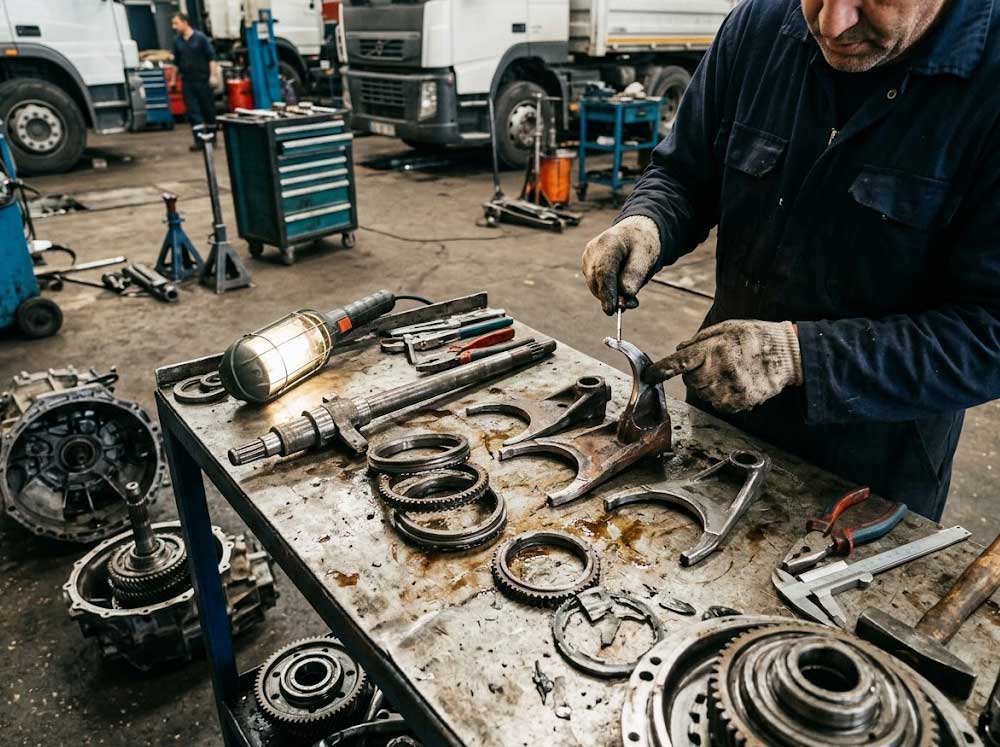
The Mechanical Function and Kinematic Working Principle of the Transmission Shift Fork
In the manual or automated manual transmissions of heavy commercial vehicles (PowerShift, Opticruise, I-Shift, TipMatic, etc.), shift forks are among the basic mechanical transmission levers that push and pull the shift sleeves (the sliding synchronizer collars). For the gears arranged on the transmission main shaft to lock together and transmit rotational torque, the synchronizer sleeve must sit fully, with a complete stroke, on the claws of the relevant gear. The parts that physically provide this axial sliding motion are the shift forks. Working inside the transmission housing under constantly high oil pressure, friction forces and axial loads, these forks are manufactured from high-strength forged steel or cast alloys with special bronze pad coatings. However, the mechanical moment they are subjected to during gear changes and the rotational friction on their constantly contacting surfaces cause millimeter-scale wear and thinning at the fork tips over time.
This wear at the fork tips prevents the shift sleeve from fully engaging the synchronizer claws and leaves the engagement depth incomplete. Because every fork inside the transmission controls a specific gear pair, wear on even a single fork tip causes constant trouble in particular gears. When the gear is not fully seated, the gear slips out of mesh and falls into neutral when the vehicle comes under load or when the throttle is released and applied again. This endangers driving safety, causes the vehicle to suddenly lose power during a climb and leads to chain damage inside the transmission.
Physical and Mechanical Causes of Gears Jumping Out of Mesh (Slipping into Neutral)
When heavy-vehicle drivers complain that the vehicle suddenly drops into neutral while moving, especially in the low gears where torque is highest or in the high-speed gears on long hauls, this is the clearest indication of mechanical wear inside the transmission. To keep gears and synchronizer claws locked together, the tooth surfaces have a special back-taper geometry. As long as the engine produces torque, this special angle prevents the shift sleeve from escaping outward. However, when the shift fork is worn, the sleeve cannot advance fully over the claws and the back-taper mechanism loses its function. Torque fluctuations during acceleration or engine braking push the half-engaged sleeve backwards, and the gear pops out of mesh with a noise and drops into neutral.
Another critical factor that causes gears to jump out of mesh is axial play in the transmission shafts and wear of ball or roller bearings. When the countershaft or main shaft bearings wear, the shafts shift off their axis by a fraction of a millimeter under load. This axis shift disturbs the alignment of the shift fork on the sleeve and places abnormal, uneven pressure on the fork surface. In addition, when the detent ball and spring mechanism loses its elasticity or its seat wears, the holding force that keeps the shift rail in place is reduced and the tendency of the gear to jump out of mesh multiplies.
Effects of Driver Habits, Incorrect Operation and Oil Quality on Shift Fork Wear
Certain incorrect operating habits of heavy-vehicle drivers in traffic are among the main factors that directly shorten the life of the shift fork and synchronizer. Keeping a hand constantly on the gear lever while driving and applying even slight physical pressure to it strains the shift linkages and cables under the cab, so that the fork is constantly in contact with the groove of the rotating sleeve. This constant contact breaks the oil film, causes micro-level welding (scuffing) and makes the fork tips wear and thin quickly. In automated transmissions, incorrect shift robot calibration or delays in the pneumatic solenoid valves cause the fork to strike the sleeve with excessive force, paving the way for mechanical bending.
When the clutch does not fully disengage because of hydraulic leaks or misadjustment in the clutch system, the transmission input shaft keeps rotating during gear changes. If a gear is engaged before the synchronizers have equalized speed, the shift fork meets enormous resistance and the fork arms bend. In addition, neglecting transmission oil change intervals, the drop in oil viscosity at high temperatures and metal debris accumulating in the oil increase the coefficient of friction between the fork and the sleeve and accelerate the wear process.
Professional Diagnosis and Disassembly Procedures for Transmission Shift Fork Wear
To correctly identify the source of the fault on a heavy vehicle that comes to the workshop with a complaint of gear jumping out of mesh, or of grinding and stiffness during shifts, a staged inspection procedure must be followed. First, the vehicle's gear shift control mechanism, external shift cables, tower connections and pneumatic shift booster cylinders must be checked. If there is no binding or misadjustment in the external mechanism, the fault points directly to the internal transmission mechanism. At this stage the transmission is lowered from under the vehicle onto a special bench, and the top cover and side mechanism housings are removed to reach the internal parts.
After the transmission has been disassembled, the shift forks are removed one by one and inspected visually and with measuring instruments. The contact surfaces of the fork tips are measured with a precision caliper or micrometer and compared with the tolerance limits in the manufacturer's technical repair catalog. Forks that have fallen below the standard thickness, show excessive scuffing marks on the surface or have turned blue from high heat (thermal discoloration) must never be reused. In addition, the straightness of the fork rails and the detent ball seats must be checked with an axial dial indicator.
Transmission Overhaul Processes, Parts Renewal and Correct Installation Criteria
Worn or bent shift forks cannot be reused by filling them with weld or straightening them, because their structural metallurgical properties have been compromised; they must be replaced with new ones that meet original equipment (OEM) standards. Replacing only a single part during fork replacement does not offer a long-term solution. The synchronizer sleeve that the fork contacts, the gear claws on which the sleeve locks, the synchronizer brass rings and the shaft bearings must also be inspected thoroughly, and all components found worn must be replaced as a set.
During installation, the transmission main shaft clearances and countershaft axial play must be adjusted precisely according to the manufacturer's shim tolerances. The working clearance of the newly installed shift forks in the sleeve grooves must be checked, and the contact surfaces must be lubricated with assembly grease during installation. After the transmission is closed, synthetic transmission oil approved by the manufacturer and containing extreme-pressure and heavy-load additives must be added to the full level, and on automated transmissions a diagnostic tool must be connected and the shift robot basic setting (adaptation) procedures must be completed in full.
Maintenance Discipline That Extends Transmission Life in Fleet Operations and Mesay Otomotiv Solutions
So that transmission failures do not lead to breakdown costs, trip delays and high repair expenses in heavy commercial vehicle fleets, great importance must be given to periodic maintenance discipline. Fleet managers should regularly inform drivers about correct shifting techniques and about not holding the gear lever while driving. At every transmission oil change, the metal deposits on the magnetic drain plug should be inspected, and in case of excessive swarf the transmission should be taken into preventive maintenance before it seizes.
With our decades of technical experience in heavy commercial vehicle transmission, differential, engine and driveline components and our strong stock infrastructure, we supply the logistics sector with original shift forks, synchronizer sets, transmission gears, sleeves and repair kits for all heavy-vehicle groups such as MAN, Mercedes-Benz, Scania, Volvo, Ford Cargo, Iveco and Renault. To keep your fleet's gear-shift stability at the highest level, solve gear-jumping problems at the root and guarantee uninterrupted performance of your vehicles, we continue to be your most reliable business partner with our wide product range and fast logistics network.
