


Volvo FH I-Shift Transmission Clutch Actuator (Clutch Cylinder) Failure Symptoms
The Volvo FH series, among the most reliable and highest-performing tractor units in the world for international haulage, heavy-duty logistics and long-distance freight, draws its power and driving comfort largely from the legendary I-Shift automated transmission technology. This intelligent transmission system, which performs gear changes within milliseconds without the driver feeling a manual clutch pedal, both maximises fuel economy and minimises the mechanical load on the driveline. At the centre of the Volvo I-Shift system sits the clutch actuator mechanism, also known as the clutch cylinder, which disengages and engages the clutch pressure plate and disc with electro-pneumatic precision and transfers engine torque to the gearbox. Taking the place of the driver's left foot, this high-tech actuator unit moves the clutch fork using compressed air, following signals received from the vehicle's electronic control unit. However, in Volvo FH tractors that cover hundreds of thousands of kilometres under loads weighing tons, in harsh climates and road conditions, the mechanical, pneumatic or electronic wear that develops in the clutch cylinder over time directly affects driving stability. Correctly reading the early warning signs that appear on the vehicle when the clutch cylinder fails plays a critical role in preventing the transmission from locking up completely and avoiding costly overhaul processes.
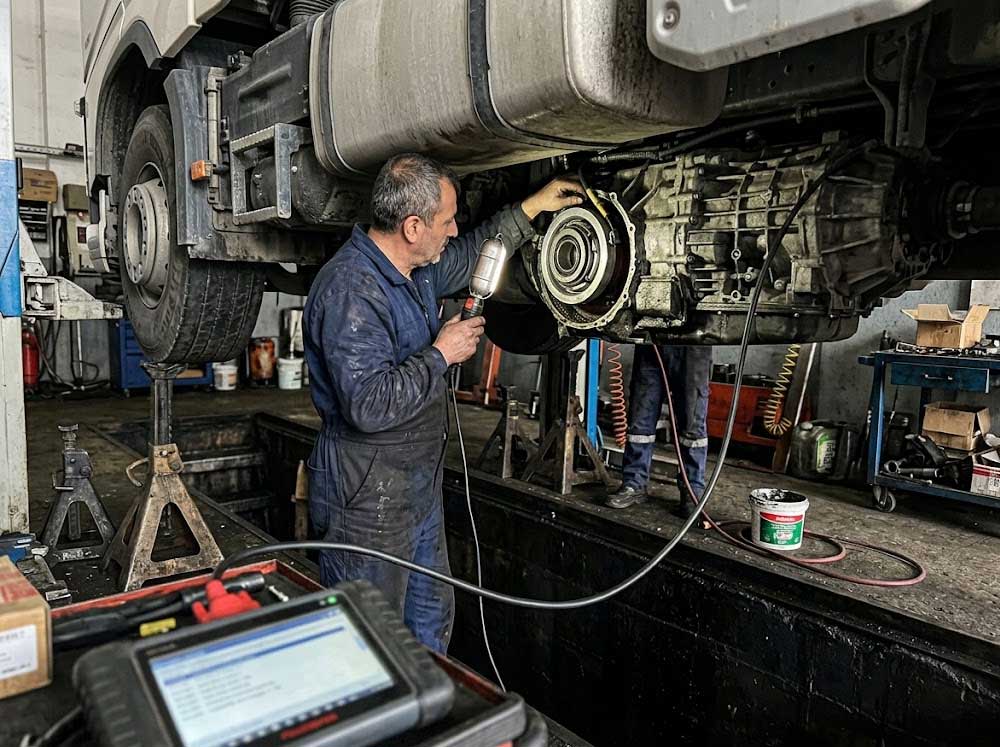
Volvo I-Shift Transmission Technology and the Working Principle of the Clutch Actuator System
In the Volvo FH I-Shift transmission architecture, the clutch actuator unit is an electro-pneumatic module integrated onto or into the side housing of the gearbox casing. Unlike the hydraulic clutch master cylinders of classic systems, the I-Shift actuator system uses high-pressure air supplied from the vehicle's pneumatic air system. The transmission electronic control unit evaluates dozens of parameters instantly, such as engine speed, vehicle speed, accelerator pedal position and torque demand, and sends commands to the sensitive solenoid valves inside the actuator. With these commands, the pneumatic piston inside the cylinder slides forward or backward in millimetre steps and applies pressure to the clutch release bearing. In this way, the engagement and disengagement points of the clutch (the stroke distance) are managed with a millisecond timing precision that a human driver could never achieve. The clutch position sensor located inside the system reports the distance travelled by the piston to the brain in real time, allowing the software to complete gear changes smoothly. Pressure loss or mechanical sticking occurring at any point of this complex structure can paralyse the entire transmission management.
Main Driving and Gear-Shift Symptoms of Clutch Actuator Failure
Among the clutch cylinder failure symptoms that Volvo FH users and fleet managers encounter most often in the field are harsh gear changes, knocking and excessive jolting. During gear changes that should normally be silky smooth, if the clutch actuator unit cannot release air in a balanced way or the piston suddenly runs free, the synchromesh rings and gears inside the gearbox strike each other hard. This creates a violent knocking sensation in the cab. Another distinct failure symptom is violent shaking and a clutch-slip sensation when the vehicle pulls away. When the internal sealing elements of the clutch cylinder wear out, the piston cannot hold the engagement point steady, and while the vehicle is moving the clutch disc slips and makes the vehicle shudder. Drivers often interpret this as the clutch lining being worn out, but the problem very often stems from the clutch cylinder being unable to hold air.
In more advanced actuator failures, very dangerous situations occur, such as the transmission suddenly dropping into neutral while the vehicle is cruising, or a gear sticking in one position. The moment the transmission control unit detects that the position sensor data from the clutch cylinder is faulty or that the clutch is not fully disengaging, it puts the system into safe mode and locks the gears to prevent the gears from breaking. Warning messages such as "I-Shift Fault", "Transmission Performance Degraded" or "Clutch Overload" appear on the digital instrument cluster. When the vehicle locks up, the driver cannot shift up or down; the vehicle drops to idle and loses traction. In addition, if the vehicle shows a tendency to lurch suddenly forward in stop-and-go traffic or during parking manoeuvres, this is a clear indication that the clutch cylinder cannot release pressure gradually and that urgent service intervention is required.
Main Mechanical and Pneumatic Causes of Clutch Cylinder Failures
Behind Volvo FH I-Shift clutch actuator failures there are generally factors such as air quality, heat stress and material fatigue. If the vehicle's air dryer (APU) filter is not replaced periodically, moisture, oil vapour and fine sediment get into the pneumatic system. This contaminated air reaches the transmission air block and the clutch actuator unit directly. The micron-precision O-rings, seal sets and solenoid valve cores inside the actuator lose their properties because of oil and moisture build-up; the rubber components swell or harden and begin to leak. Air leaks that develop inside prevent the piston from reaching the required pressure level and cause the clutch engagement distance to drift.
In addition, mechanical wear in the clutch fork, bearing and ball mechanisms working inside the gearbox housing also places the actuator unit under excessive load. Play developing in the clutch fork bearings or hardening of the pressure plate diaphragm applies much higher resistance than normal to the piston of the clutch cylinder. This extra resistance causes the piston rod inside the actuator to bend, the cylinder bore to be scratched and the internal sealing to collapse completely. Furthermore, oxidation or solder cracks developing over time in the electronic circuits of the clutch position sensor integrated in the actuator body, because of high operating temperature and vibration, cause the system to give a fault warning even though there is no mechanical problem.
Diagnostic Procedures, Calibration (X-Y Parameter Learning) and Maintenance Discipline
To diagnose a clutch actuator failure correctly on Volvo FH vehicles, the vehicle must first be scanned electronically with authorised diagnostic equipment (Volvo Tech Tool, PTT). When the fault codes are examined, clutch stroke distance exceedance or solenoid valve current faults can be detected. However, replacing parts based on the fault code alone does not always provide a definitive solution. Mechanically, the air supply pressure of the clutch cylinder should be measured with a pressure gauge, and micron-level air leaks that can be heard from outside the cylinder should be checked with soapy water or ultrasonic detectors.
After a clutch actuator replacement or overhaul, the most critical stage is calibrating the new part to the transmission brain. In this procedure, called "Clutch Engagement Point Calibration", the zero point of the clutch cylinder, the full disengagement point and the lining wear parameters are taught again to the transmission control unit through the diagnostic device. Unless the calibration is completed successfully, even a newly fitted actuator will run jerkily or will not allow gear changes. For this reason, software adaptation procedures must always be carried out completely after part replacements.
The Importance of Timely Intervention in Heavy-Duty Fleets in Terms of Cost and Safety
In the logistics sector, a truck being stranded on the road does not mean only that a tractor unit has broken down; it also means late-delivery penalties, high roadside assistance costs and damaged customer trust. When a clutch actuator failure in a Volvo FH I-Shift transmission first shows its symptoms, early intervention can be resolved at quite reasonable cost by replacing only the clutch cylinder or the seal kit inside it. However, if the fault is ignored and the vehicle is kept running by force, irregular clutch movement burns the clutch disc, scores the flywheel surface and breaks the synchromesh brass rings inside the gearbox, leading to huge transmission overhaul costs of tens of thousands of euros. Considering the accident risk of sudden gear lock-ups while driving, the vital importance of clutch cylinder maintenance becomes even clearer.
Choosing OEM-Quality Parts and Mesay Otomotiv Solutions
The quality of spare parts used in heavy-duty transmission overhauls is the most fundamental factor that determines the life of the workmanship. In high-technology transmission systems such as the I-Shift, choosing aftermarket actuator units or low-quality seal sets that cannot withstand heat, pressure and vibration causes the fault to recur in a very short time. Parts manufactured to original equipment standards, with high-precision position sensors and pressure-resistant solenoid valves, should be preferred.
At Mesay Otomotiv, with our decades of expertise in the heavy commercial vehicle sector, our wide stock structure and our technical know-how, we offer all clutch actuator (clutch cylinder) parts, seal sets and driveline components for Volvo FH I-Shift transmission systems to the logistics sector. To keep your fleet moving without interruption on the road, to restore gear-shift stability to day-one precision and to reduce your operating costs, we continue to provide fast logistics support to your workshops with our highest-quality spare parts solutions and to be your reliable business partner.
